
2026 Buying Guide and Market Review
The list price of an EV rarely matches its actual outlay or its cost per kilometre. We break down the real price ranges by segment in the Spanish market, the limits of state aid, and the direct impact of energy costs compared to internal combustion engines.
Quick summary
- The average asking price is €45,335 in the new vehicle channel in Spain, although the average declared intention by private individuals is €33,927.
- The minimum purchase threshold for a BEV car starts between €16,245 and €17,890 before applying grants to urban models such as the Dacia Spring or the Leapmotor T03.
- The maximum limit to access state incentives is €45,000 excluding VAT (€53,000 for 8 or 9 seats), excluding high-end and luxury ranges from public schemes.
- Home charging during off-peak hours costs between €1.80 and €3.50 per 100 km, compared to the €9.50 or €12.50 required by an equivalent internal combustion vehicle.
- The average payback period for the initial surcharge ranges from 3 to 6 years for regular use of 15,000 km per year with preferential overnight home charging.
How much does an EV really cost in Spain today?
The battery electric vehicle (BEV) market in Spain shows a persistent gap between the average advertised price and the budget capacity of the private user. According to the GANVAM market barometer and transactional offer data, the average asking price for a new EV in Spain is around €45,335. However, the budget that drivers expect to spend is around €33,927, according to automotive sector studies.
This difference reveals that the private buyer does not usually pay the full list price. The actual final cost depends on three corrective factors: manufacturers' promotional policies, tax deductions and state incentives, and, above all, the Total Cost of Ownership (TCO), where the cost per kilometre for electricity offsets the initial surcharge compared to internal combustion.
Analysis criterion: QuantumDrive's catalogue compares 579 EV models. In this sample, the dispersion ranges from urban options below €18,000 to long-range saloons well over €80,000. To compare specifications before deciding, review the practical criteria of how to best choose your EV before buying (Available in Spanish).
Prices by segment and battery capacity
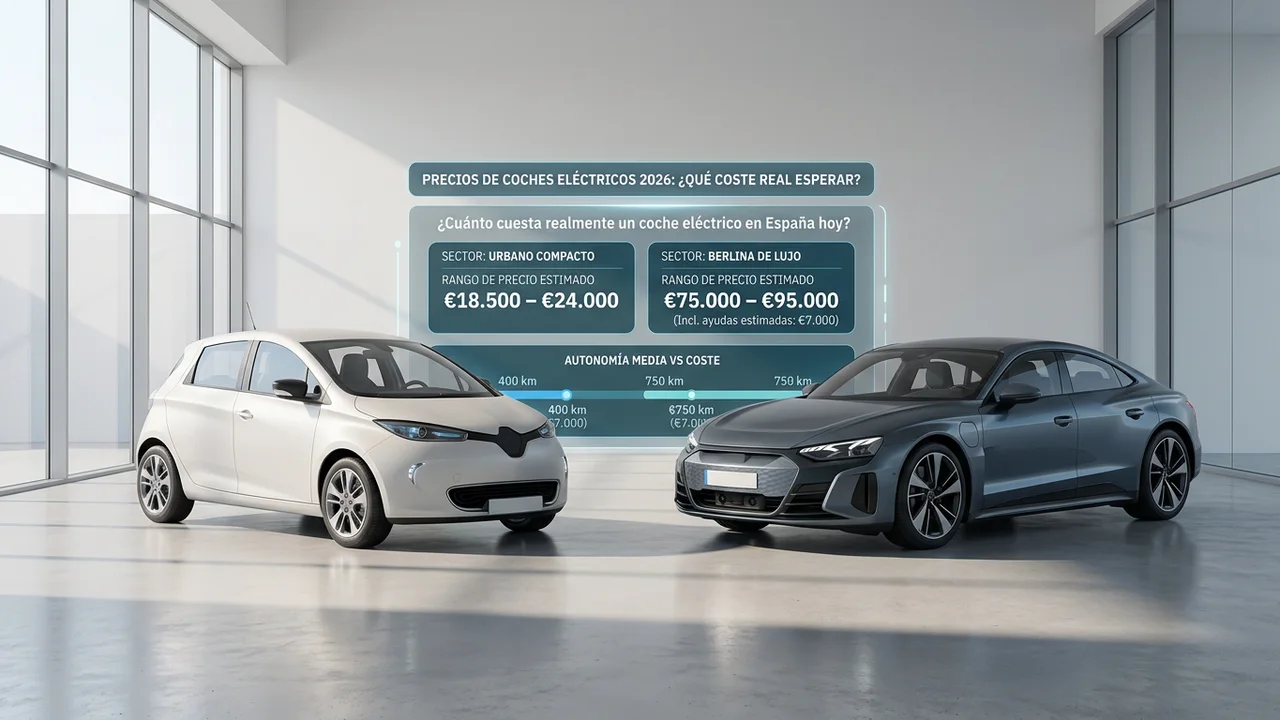
To determine what cost to expect, it is essential to segment by body size and usable battery size. The net battery capacity (the accumulated energy that effectively powers the motor for traction) is the component that most increases manufacturing cost and determines the distance that can be travelled between stops. To accurately calculate this range outside the homologation cycle, it is advisable to compare the real-world range versus the WLTP cycle.
At the entry level, the Spanish market currently offers approved urban models (M1 category) with base prices of €16,245 to €17,890 without applied grants, such as the official Dacia Spring catalogue or the Leapmotor T03. By applying the €4,500 subsidy from the Auto+ Programme and the mandatory €1,000 brand discount, the net entry cost is reduced to a range of between €10,700 and €12,300.
| Vehicle Segment | Base RRP (indicative) | Typical Net Capacity | Cost 100 km (Home off-peak) | Main Selection Criterion |
|---|---|---|---|---|
| Urban (Segment A) | €16,000 – €22,000 | 25 – 35 kWh | €1.80 – €2.20 | Daily urban and suburban journeys (<120 km/day); slow charging at a conventional socket or basic wallbox. |
| Supermini / Compact (B/C) | €24,000 – €36,000 | 40 – 60 kWh | €2.30 – €3.00 | Versatile family vehicle; real-world motorway range of 230 to 330 km; stable charging curve up to 100-130 kW. |
| Saloon / Medium SUV (D) | €38,000 – €44,900 | 60 – 78 kWh | €2.80 – €3.80 | Frequent long journeys; compatibility with high-power charging stations (>150 kW); falls within the public aid cap. |
| High-End / Premium | > €45,000 (excl. VAT) | > 80 kWh | €3.20 – €4.50 | Real-world motorway ranges over 450 km and 800 V architecture; excluded from state subsidies. |
The initial price difference compared to an equivalent internal combustion car is between €4,000 and €8,000 in the compact and supermini segments. This economic gap tends to close in the upper segments (D and large SUVs), where petrol and diesel engines already incur high registration tax brackets due to their CO₂ emissions.
EV mobility could be your best investment.
Find out how much you could save on fuel by buying an EV.
Impact of public incentives and official purchase limits
To avoid errors in financial forecasting, it is imperative to know the eligibility caps and the IDAE criteria for EV grants within the framework of incentives in Spain. No passenger car whose factory price (excluding VAT) exceeds €45,000 (or €53,000 for 8 or 9-seater variants) can receive basic state subsidy.
For models within this range, state support and deductions are provided through several complementary mechanisms:
1. Acquisition grant and commercial discount
Under the Auto+ Programme (RD 609/2026), individuals can access a basic grant of €4,500 for private passenger cars assessed under the Energy Efficiency and Emissions (EEE) scale. In parallel, regulations require dealerships to provide a mandatory commercial discount of at least €1,000, reflected on the invoice.
2. State income tax deduction
Private buyers can benefit from a deduction in the full income tax liability of 15% of the acquisition value (with a maximum computable base of €20,000), representing a direct tax recovery of up to €3,000 in the corresponding income tax return.
3. Energy Saving Certificates (CAE)
When scrapping a combustion car previously registered for a 100% EV, the final energy saving can be monetised under the system regulated by the Ministry for Ecological Transition and Demographic Challenge (MITECO) through form TRA050. You can consult our guide on how to claim the EV CAE (Available in Spanish) and review the steps to find out how the CAE is calculated in 2026 (Available in Spanish), with usual payments between €750 and €950.
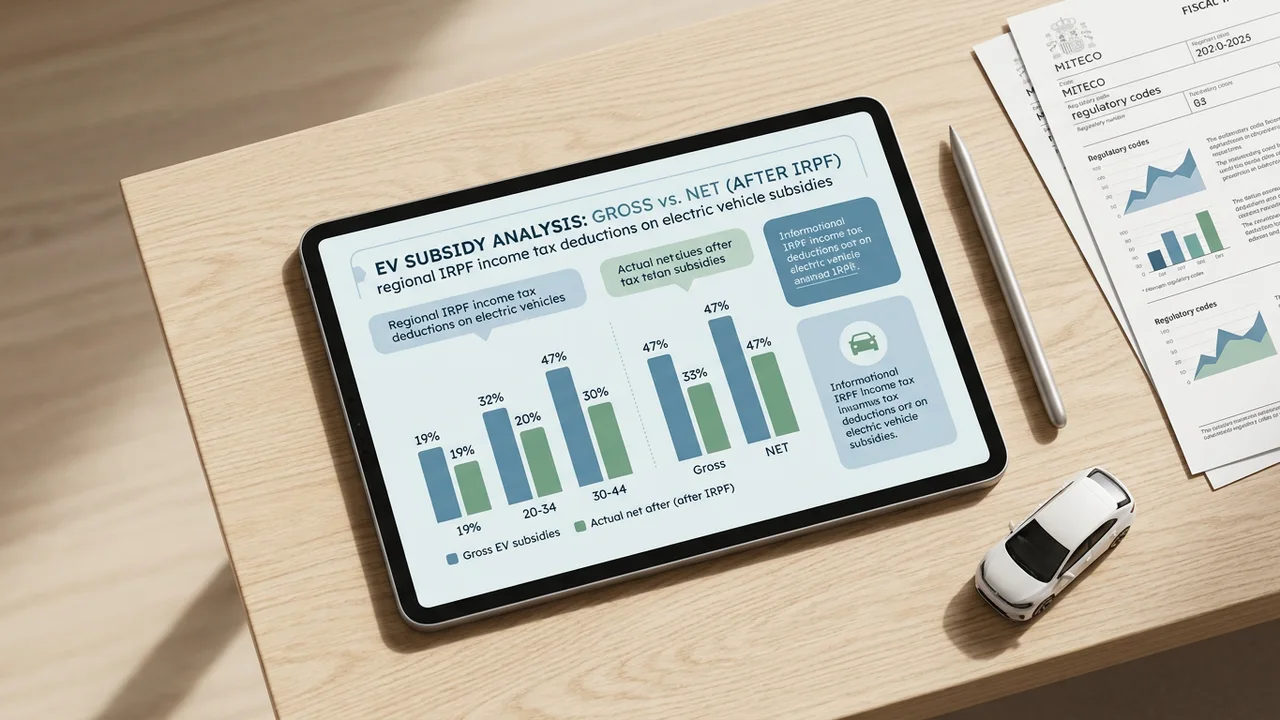
Mandatory tax impact: Remember that direct purchase subsidies are considered capital gains not derived from transfers in the general income tax base. Depending on your regional marginal tax bracket, between 19% and 47% of the amount received will return to the tax authorities in the following financial year.
Cost per kilometre: home charging versus public charging
The initial sale price of an EV does not represent the definitive economic balance. The determining factor that amortises the purchase is the running cost per 100 kilometres, which varies drastically depending on the supply infrastructure used. If you want to delve deeper into daily energy expenditure, consult our analysis on the real consumption of an EV (Available in Spanish).
The formula for obtaining the direct cost of electric fuel is as follows:
Cost per kilometre (€/km) = [Average consumption (kWh/100 km) / 100] × [Electricity price (€/kWh) × 1.10]
The 1.10 factor incorporates a standard estimate of 10% energy losses during the AC to DC conversion process by the on-board charger (OBC).
By applying the official electricity prices according to ESIOS in time-of-use tariffs (off-peak period from 00:00 to 08:00, with costs from €0.10 to €0.18/kWh), a car consuming 16 kWh/100 km requires between €1.80 and €3.50 per 100 km.
In contrast, charging at ultra-fast public charging points on motorways (power outputs from 150 kW to 350 kW for journeys) sets tariffs between €0.45 and €0.79 per kWh. In this roaming scenario, travelling 100 km costs between €7.50 and €12.00, a figure that equals or approaches the fuel cost of an efficient diesel engine. To avoid unnecessary surcharges on the road, it is advisable to know the criteria for EV charging points before plugging in (Available in Spanish).
Initial hidden costs: the dedicated charging point
Unless the user already has compatible infrastructure, purchasing an EV requires budgeting for the installation of a dedicated charging point (wallbox). This initial cost varies between €700 and €1,800 depending on the technical complexity of the property.
The parameters that determine this amount are:
- Cabling distance: The run of halogen-free cable from the main distribution board or central meter to the parking space. If the distance exceeds 15-20 metres in communal garages, the cost of labour and materials increases significantly.
- Regulatory protections (ITC-BT-52): It is mandatory to install a Type A residual current device or one specific for EVs with DC leakage detection (6 mA DC), in addition to a dedicated miniature circuit breaker and a transient and permanent surge protector.
- Dynamic load balancing system: A sensor module that adjusts the power delivered to the car in real-time according to the instantaneous consumption of the home, preventing trips of the limiter and saving the monthly cost of contracting more power with the energy supplier.
Amortisation rule: A driver covering 15,000 km per year saves, on average, between €1,000 and €1,200 annually on energy if 85% of their charging is done at home during off-peak hours. This way, the €1,200 investment in the wallbox is fully recovered within the first year and a half of the vehicle's use.
Recommended guides on costs and range
Actual consumption and energy calculation
Understand the weather and speed factors that alter kilowatt-hour expenditure compared to technical specifications in our analysis of the actual consumption of an EV (Available in Spanish).
Monetisation and CAE procedures
Learn how to process compensation for the purchase or replacement of your internal combustion car by reviewing the guide on how to claim the CAE in 2026 (Available in Spanish).
Motorway range and tests
Adjust your budget by understanding the real gap between catalogue figures and motorway journeys with our comparison of actual range versus WLTP.
Plan with QuantumDrive, travel with peace of mind.
Discover your optimal route taking into account EV charging points and your actual range.
Frequently asked questions about EV prices
How much does the cheapest new EV really cost in Spain?
Entry-level models approved as passenger cars (category M1) currently start from a range of €16,200 to €18,000 cash price before incentives (such as the Dacia Spring or the Leapmotor T03). Applying the basic aid of €4,500 from the Auto+ Programme and a dealer discount of €1,000, the final cost can be between €10,700 and €12,300.
How long does it take to amortise the extra cost compared to a petrol car?
Covering an average of 15,000 km annually with 85-90% overnight charging at domestic off-peak rates, fuel savings are around €1,000 to €1,300 per year. Adding the lower cost of mechanical inspections and municipal taxes, the typical surcharge of €5,000 to €7,000 compared to an equivalent internal combustion passenger car is amortised between 3 and 6 years of use.
Which models are excluded from public aid due to price?
All passenger vehicles whose selling price without VAT (ex-works price plus transport) exceeds €45,000 are excluded from direct state aid, a threshold that is extended to €53,000 for 8 or 9-seater vehicles. All premium offerings exceeding this amount must be purchased without purchase subsidies.
Is it mandatory to install a 7.4 kW charger at home or is a common socket sufficient?
It is not legally mandatory for charging, but a conventional Schuko socket is technically limited for safety to 2.3 kW continuous and suffers greater thermal losses. A specific 7.4 kW (32 A) EV charging point allows 50 to 60 kWh batteries to be recovered in a single night and complies with the safety standard of the ITC-BT-52 regulation.
Is comprehensive insurance for an EV more expensive than for a combustion car?
It is usually between 10% and 25% higher for mid-range and high-end models due to the cost of battery replacement in the event of structural damage and the hourly rate of specialised labour for high-voltage bodywork, although this difference has progressively reduced as the volume of certified workshops has increased.