
Regulatory framework and incentives 2026
The budgetary replacement of the MOVES III Plan by the Auto+ Programme coexists with the Energy Saving Certificates (CAE) system. We analyse the legal compatibility, the requirements of the TRA050 V2.0 form, and the financial strategy to accumulate up to €9,500 gross in state aid, deductions, and private incentives.
Up to €5,500
Auto+ Plan (State + brand)
€4,500 in direct state aid plus a mandatory commercial discount of €1,000 on the invoice.
€750–€950
Estimated incentive per CAE
Monetisation of energy savings with the official TRA050 V2.0 form when replacing a combustion passenger car.
Up to €3,000
15% Income Tax Deduction
Tax relief on a maximum deductible base of €20,000 in the income tax return.
Quick summary
- Legal compatibility confirmed: The Auto+ Programme (managed by the Ministry of Industry and Tourism) and the Energy Saving Certificates (regulated by MITECO) are fully cumulative. The CAE is not a public competitive grant, but a commercial consideration for the verified transfer of energy savings.
- Purchase price cap set at €45,000: For an EV passenger car (M1 category) to be eligible for the Auto+ Plan, the ex-works price before tax (RRP without VAT) must not exceed €45,000.
- Mandatory commercial discount of €1,000: By regulatory requirement, the manufacturer or dealer must apply a minimum direct discount of €1,000 before tax on the sales invoice.
- Scrapping required only for the CAE: The Auto+ Plan does not mandatorily require scrapping an old vehicle to settle the basic aid, but the TRA050 V2.0 form of the CAE system does mandatorily require removing a combustion vehicle.
- Strict time window of 3 months before or 6 months after: The definitive deregistration with the DGT or the transfer of the internal combustion car must be strictly registered between 3 months prior and 6 months after the first registration of the new EV.
- Cumulative savings between €5,900 and €9,500: By combining the up to €4,500 state aid from the Auto+ Plan, the €1,000 commercial discount, the CAE (typically between €750 and €950, potentially exceeding €1,000) and up to €3,000 from the 15% Income Tax deduction, the total gross saving reaches up to €9,500.
Are the Auto+ Plan and the CAE system compatible?
The legal answer is unequivocal: yes, they are 100% compatible. The usual confusion stems from the general regime of incompatibilities of public subsidies in Spain, which prohibits financing the same subsidised event with two concurrent funding lines. However, the Auto+ Programme and the Energy Saving Certificates system operate under entirely different legal natures.
The Auto+ Plan is a direct public subsidy approved by the Government of Spain with a budget of €400 million (€350 million for individuals in Line 1 and €50 million for fleets in Line 2) channelled by the Ministry of Industry and Tourism, designed as a new programme after the closure of the MOVES III Plan on 31 December 2025. In contrast, the Energy Saving Certificate is based on Royal Decree 36/2023 establishing the CAE system, administered by the Ministry for Ecological Transition and Demographic Challenge (MITECO). As we explain in our guide on EV grants in 2026 and coexistence between Auto+ Plan, Income Tax and CAE (Available in Spanish), the CAE does not constitute a competitive state subsidy, but a commercial instrument for private settlement.
Regulatory incompatibility limit: The CAE system strictly prohibits computing savings that have received direct funding from the National Energy Efficiency Fund (FNEE). As the funds for the Auto+ Programme come from ordinary ministerial allocations of Industry and not from the FNEE, the concurrence does not violate any legal restriction.
Currently, the incentive landscape in Spain offers a diverse architecture. QuantumDrive has registered 186 EV grants in Spain: 157 municipal, 18 regional, and 8 state-level. Knowing how to combine these instruments without creating documentary overlaps is key to maximising the return on investment.
How the Auto+ Plan's EEE scale works
The Auto+ Plan structures aid for individuals for M1 category passenger cars on an official base of €4,500 through the so-called EEE scale, whose percentage coefficients are additive up to a maximum state cap of €4,500. This subsidy is supplemented by the mandatory discount provided by the dealer, as required by law.
The scale is structured into three technical components defined by the regulatory framework (RD 609/2026):
- E1 (Electric Criterion): Contributes 50% of the base (€2,250) for 100% battery electric vehicles (BEV) or fuel cell electric vehicles (FCEV). For plug-in hybrid electric vehicles (PHEV) or extended-range electric vehicles (EREV), this block is reduced to 25% (€1,125).
- E2 (Economic Criterion): It grants 25% (€1,125) if the vehicle's pre-tax purchase price (RRP without VAT) is equal to or less than €35,000. If the price falls within the €35,001 to €45,000 bracket, the contribution drops to a fixed 15% (€675). Passenger cars exceeding €45,000 before VAT are completely excluded from the aid.
- E3 (European Manufacturing Criterion): Adds 15% (€675) if the final assembly of the vehicle takes place within the European Economic Area, and an additional 10% (€450) if the traction battery cells have been produced in European Union plants.
Alongside the state amount, the regulation requires the brand to apply a minimum mandatory commercial discount of €1,000 directly reflected on the pre-tax sales invoice, as detailed in our analysis to determine which of the various EV grants to choose to save the most (Available in Spanish). In the optimal scenario of a BEV passenger car manufactured in the European Union costing less than €35,000, the immediate dealer discount and the consolidated subsidy total €5,500 gross.
Auto+ grant: how it is calculated
| Factor | What counts | Share of the maximum grant |
|---|---|---|
| Maximum grant | Private buyer / self-employed or micro-business | €4,500 / €6,000 |
| E1 · Electric | Battery electric / plug-in hybrid | 50% / 25% |
| E2 · Economic | Price before tax up to €35,000 / up to €45,000 | 25% / 15% |
| E3 · European | Assembled in the EU / battery made in Europe | +15% / +10% |
| Price cap | Above €45,000 before tax | Not eligible |
| Brand discount | Applied on the invoice by the manufacturer | At least €1,000 |
Example: a private buyer choosing a battery electric car priced at €28,000 before tax, not assembled in the EU, gets 50% + 25% = 75% of €4,500, that is €3,375, plus the brand discount of at least €1,000. Indicative only: the dealer processes the grant and it depends on the funds available.
Electromobility can be accessible to you.
Discover all the aid and benefits you can apply for and their value.
Requirements and calculation of ESC under TRA050 V2.0 form
To monetise Energy Saving Certificates when changing cars, the applicable regulation is based on the standardised form TRA050 V2.0 published in the Official State Gazette within the catalogue managed by MITECO. This form regulates the replacement of internal combustion engine vehicles with battery electric models for private use.
The official formula determines the kilowatt-hours saved annually (\(AE_{kWh/año}\)):
Official MITECO formula (TRA050 V2.0 form):
AE = [((CVA · f - CVN) / 100) · L] · Fp
- CVA (Old vehicle consumption): Standardised value per table in litres/100 km (actual consumption or approved consumption from the old car's data sheet is not used). For petrol passenger cars, it is set at 7.89 L/100 km; for diesel, at 6.88 L/100 km; and for conventional non-plug-in petrol hybrids, at 5.97 L/100 km.
- f (Fuel to energy conversion factor): 9.19 kWh/L for petrol and 10.00 kWh/L for diesel.
- CVN (New EV consumption): Approved consumption according to the official database of the Institute for Energy Diversification and Saving (IDAE). For the purposes of an average market estimate, a reference of 17.92 kWh/100 km is usually taken.
- L (Standardised annual mileage): For passenger cars (M1 category), it is set by ministerial order at 12,295 km per year.
- Fp (Age weighting factor): 1.0 for vehicles under 10 years old; 1.10 between 10 and 15 years; 1.15 between 15 and 20 years; and up to 1.30 for vehicles over 30 years old.
For a step-by-step mathematical breakdown and detailed explanations, you can consult our article on how the ESC of an EV is calculated (Available in Spanish). Settlement is made at a value of €120/MWh net for the customer. With these scales, the compensation to the buyer typically ranges between €750 and €950, and can exceed €1,000.
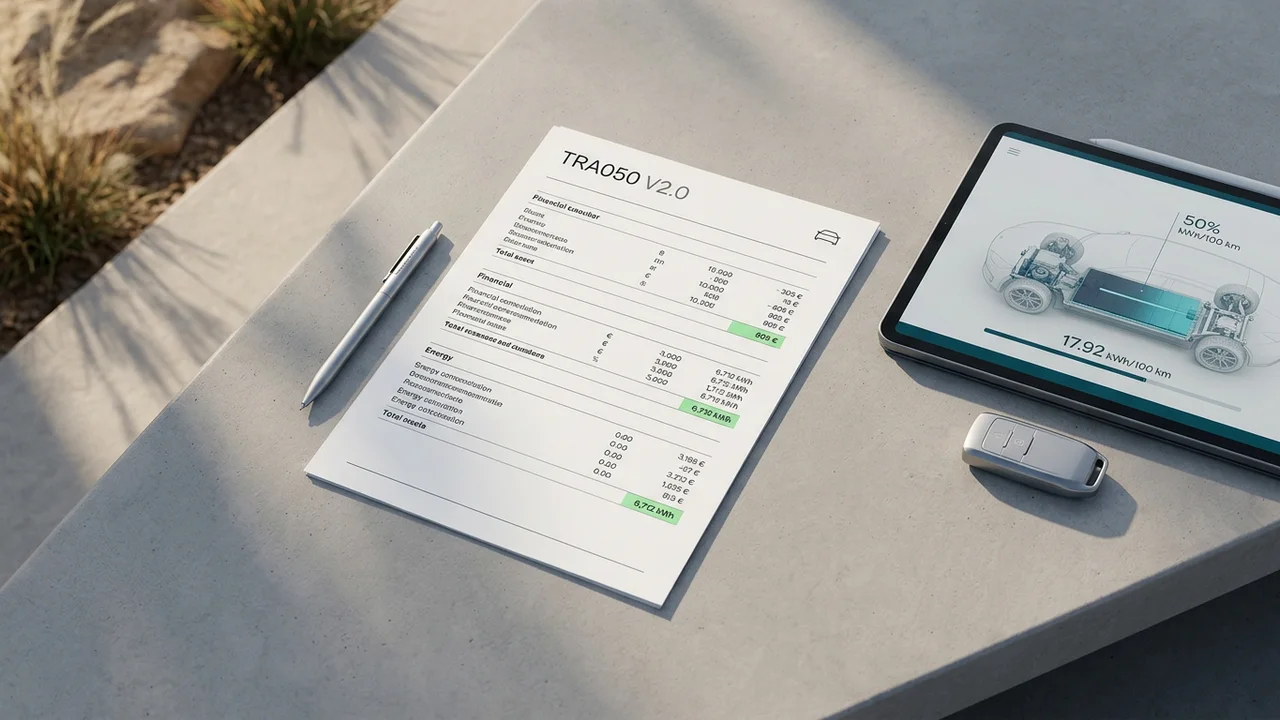
As a specific case of technical settlement, with the TRA050 V2.0 form, replacing a petrol passenger car less than 10 years old with an EV of 17.92 kWh/100 km generates about 6,712 kWh of savings, approximately €805 of ESC according to QuantumDrive's calculation. If that same petrol car were between 10 and 15 years old, the multiplier factor would raise the estimated amount to €886.
Essential documentary conditions of the TRA050 V2.0 form
- Same ownership: The natural or legal person acquiring the EV must be the same owner of the replaced combustion vehicle.
- Minimum prior permanence of 2 years: The old car must have been registered in the applicant's name for at least two years immediately prior to the date of the operation, evidenced by the circulation permit or the last two paid receipts for the Vehicle Excise Duty (IVTM). Consult our list of necessary documentation to process the EV ESC (Available in Spanish).
- Valid MOT: The combustion vehicle must have had a valid MOT (technical vehicle inspection) for at least 9 of the last 12 months prior to its deregistration or transfer.
- Strict time window: The definitive deregistration with the Dirección General de Tráfico (DGT) with a certificate of destruction from a CAT centre, or the verifiable sale of the internal combustion vehicle, must take place between 3 months before and 6 months after the date of first registration of the new EV. The date of the order contract or the invoice is not counted.
- Prohibition of sale between cohabitants: If the old vehicle is transferred to a third party instead of being scrapped, sales between people sharing the same registered address are not permitted.
Comparative table: cumulative breakdown of savings in 2026
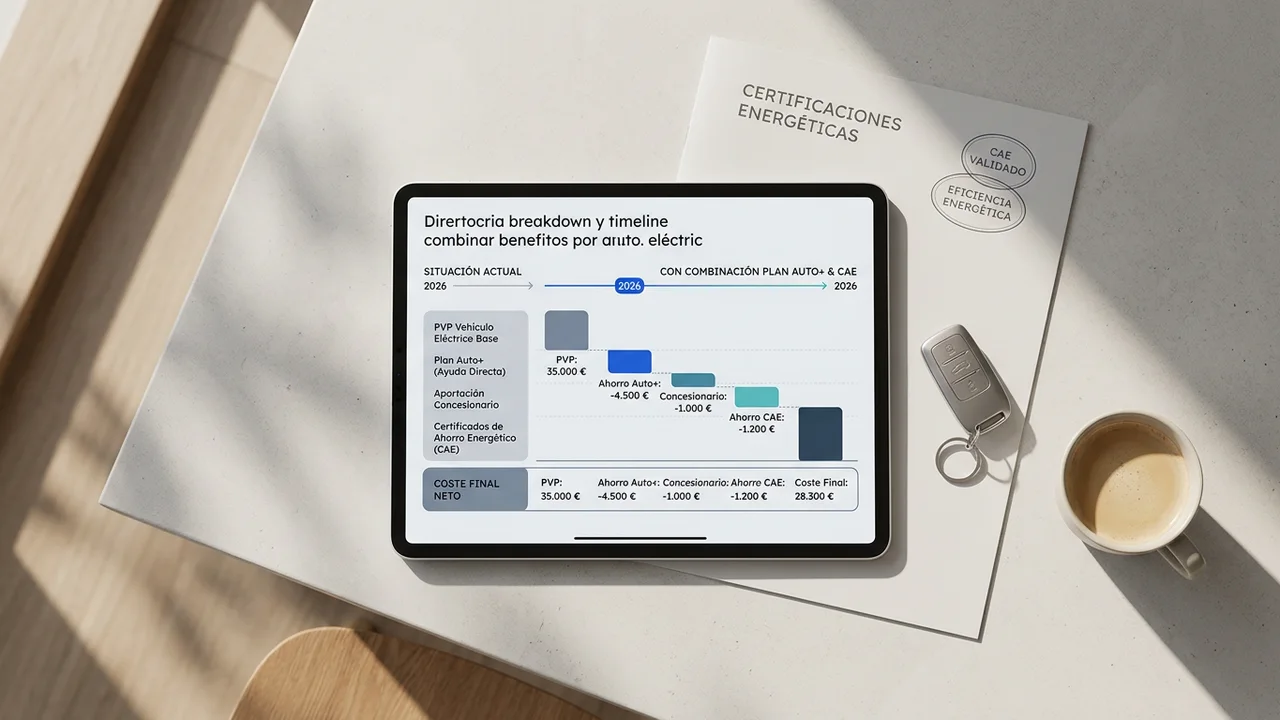
The strategic combination of the four mechanisms currently in force in Spain allows for a substantial reduction in the net acquisition cost of a pure EV. Below, we analyse how each incentive layer operates on an M1 passenger car with an ex-works price of less than €35,000.
| Incentive concept | Mechanism and body | Indicative amount | Settlement time | Key requirement |
|---|---|---|---|---|
| Auto+ Plan (State) | Direct subsidy (Ministry of Industry) | Up to €4,500 | Centralised administrative payment | RRP excluding VAT less than €45,000 |
| Dealership contribution | Mandatory commercial discount | €1,000 | Directly on the sales invoice | New M1 model registered |
| CAE compensation (TRA050 V2.0) | Transfer of energy saving (MITECO) | Typically between €750 and €950, potentially exceeding €1,000 | Settlement after validation and verification of the file | Scrapping of internal combustion vehicle (+2 years ownership and MOT) |
| State income tax deduction | Tax relief on quota (AEAT) | Up to €3,000 (15% of max. €20,000) | Annual Income Tax Campaign | New vehicle not used for economic activity |
| Potential accumulated gross savings | Between €5,900 and €9,500 (according to EEE scale and deduction) | |||
The dealership's contribution reduces the outlay on the day of purchase, while the CAE is settled once the validation and verification of the file with the delegated entity is completed, without being subject to administrative resolution calendars. To delve deeper into collection, review our complete guide to the EV CAE and how to collect it (Available in Spanish).
How to coordinate both procedures step by step
To simultaneously collect the Auto+ Plan aid and monetise the CAE without making formal errors, a rigorous chronological order of execution must be followed.
Step 1: Price validation and issuance of the purchase invoice
Ensure that the invoice reflects the breakdown of the passenger car's price before VAT (which must not exceed €45,000 for M1 passenger cars) and that it explicitly contains the concept of the discount of at least €1,000 contributed by the brand under the Auto+ Plan framework. Request the technical sheet with the approved combined cycle consumption.
Step 2: Registration of the EV and date control
Accurately note the date of first registration appearing on the definitive circulation permit issued by the Dirección General de Tráfico. This day irrevocably marks the temporal clock for managing the old vehicle in the CAE system: you have a margin of up to 6 subsequent months (or 3 previous months) to formalise the deregistration or sale of the internal combustion vehicle.
Step 3: Processing the exit of the internal combustion car
If you opt for scrapping, deliver the old car to an Authorised Treatment Centre (CAT) and demand both the certificate of destruction and the telematic proof of definitive deregistration from the DGT. Check that the internal combustion vehicle's circulation permit was in your name for at least 24 consecutive months and that the MOT was valid for 9 of the preceding 12 months.
Step 4: Application for Auto+ Programme aid
The processing of the Auto+ Plan file is managed directly by the dealership at the time of sale, providing the technical and commercial documentation required by the programme's regulations.
Step 5: Transfer of rights and collection of the CAE file
Formalise the transfer of energy savings by signing the TRA050 V2.0 transfer agreement along with the responsible declaration required by MITECO (certifying that there are no concurrent aids from the FNEE or transfers between cohabitants). Royal Decree 36/2023 grants a period of up to 3 years from purchase to register the savings, with payment settled after verifying the corresponding documentation.
Tax impact: Income Tax and taxation of each incentive
The tax treatment with the Tax Agency is not identical for all components of the operation. Knowing the differences avoids unexpected deviations in the Income Tax return:
1. Treatment of the Auto+ Plan
The public aid paid by the Ministry of Industry and Tourism is taxed as capital gain not derived from the transfer of assets. This means that the amount received (up to €4,500) is added to the general income tax base, taxed at the taxpayer's marginal rate (usually between 19% and 47% depending on the income level and the autonomous community of residence). It is essential to set aside a percentage of the aid to settle this tax adjustment the following year.
2. Treatment of Energy Saving Certificates (CAE)
Remuneration for the assignment of the CAE constitutes a private monetary consideration for waiving an energy saving right. If the amount is directly passed on in the purchase invoice, reducing the vehicle's cost, it lowers the asset's acquisition base. If it is received retrospectively via bank transfer after settling the file with a delegated entity, it is considered a capital gain subject to taxation in the financial year it is received.
3. 15% income tax deduction for vehicle and infrastructure purchase
State tax regulations provide for a direct deduction from the full tax liability of 15% on a maximum base of €20,000 for purchase (up to a €3,000 reduction in tax liability) and €4,000 for domestic charger installation (up to an additional €600). To calculate the deductible base, the Tax Agency requires any public subsidy received to be deducted beforehand. Therefore, if €4,500 is received from the Auto+ Plan, the computable base is calculated by deducting this amount from the total paid.
Critical errors that invalidate CAE or Auto+ Plan payments
Minor documentary oversights commonly lead to the rejection of seemingly sound applications. Before formalising the purchase, ensure you do not fall into any of these situations:
- Accepting the dealer's CAE commercial voucher without reviewing the contract: Some dealerships apply a private promotional discount in exchange for retaining ownership of the customer's energy saving rights. If you sign a prior assignment at the point of sale, you will no longer be able to process the TRA050 file independently or receive the full market settlement.
- Selling the old car to a spouse or cohabiting family member: The TRA050 V2.0 form expressly prohibits the sale of internal combustion engine cars between people registered at the same address. If the old vehicle is not sent for scrap, the transfer must be formally made to an independent third party.
- Scrapping the vehicle outside the 3-month / 6-month window: If you scrap the old car four months before the DGT registers your new EV, the MITECO inspection system will automatically reject the saving due to the expiry of the regulatory period.
- Forgetting to check the internal combustion engine car's MOT: It is not enough for the old car to have a valid MOT on the day of scrapping; it must be proven that it was up to date for a minimum cumulative period of 9 months within the previous 12 months.
- Exceeding the budget ceiling of €45,000 before VAT: Optional equipment, connectivity packages, or special paints can cause the base price to exceed €45,000, completely nullifying the Auto+ Plan subsidy.
Supplementary guides on EV grants and taxation
General framework of grants 2026: Auto+ Plan, Income Tax and CAE (Available in Spanish)
Understand how the incentive map is structured after the end of MOVES III and how to calculate your net savings after tax impact.
Complete CAE guide: delegated entities and document management (Available in Spanish)
Learn how to choose the right energy supplier or aggregator to monetise your certificates without excessive commissions.
Document checklist for processing CAE without rejections (Available in Spanish)
Review the exact list of CAT certificates, vehicle registration documents, and census proofs required by MITECO.
CAE system formulas and numerical examples (Available in Spanish)
Practical simulations with diesel and petrol cars according to standardised annual mileage and age factor.
Calculate your CAE
Discover how much you can receive for assigning your car's energy savings.
Frequently asked questions
Can I apply for the Auto+ Plan and CAE if I buy a second-hand EV?
The Auto+ Plan for individuals focuses on new vehicles registered for the first time. In contrast, the Energy Saving Certificates system (TRA050 V2.0 form) does accept used battery electric vehicles, provided they have not previously generated a CAE and documentation of deregistration or sale of the replaced combustion car is provided.
How much exact money will I receive for CAE compensation?
The amount depends on the fuel of the car being retired, its age, and the approved consumption of the EV. For a private car, the settlement typically ranges between €750 and €950, and with a petrol car over 25 years old, the age factor on the form can push it above €1,000. As it depends on the specifics of the application, it is settled as a technical estimate.
Is it mandatory to scrap an old car to claim the Auto+ Plan?
No. To access the basic Auto+ Plan grant, it is not mandatory to scrap a combustion car, which simplifies the process compared to previous schemes. However, to generate the CAE incentive through the TRA050 form, it is an essential condition to retire or transfer an internal combustion engine vehicle with at least two years of prior ownership.
How long do I have to process the CAE application after buying the car?
The general regulation of Royal Decree 36/2023 grants a general period of up to 3 years from the execution of the action to register the savings. However, the removal of the combustion vehicle (deregistration or sale) must strictly occur between 3 months before and 6 months after the EV's registration.
Do plug-in hybrids generate the same CAE savings as a pure EV?
No. The standard TRA050 V2.0 form for private cars requires the new replacement vehicle to be 100% battery electric (BEV). Plug-in hybrids (PHEV) do not generate savings under this specific private fleet replacement form, although they may access partial sections of the Auto+ Plan.
What happens with the CAE if the old car was registered to my company?
If the replaced vehicle was used for economic activity or registered in the name of a legal entity, the TRA050 form for private individuals does not apply; instead, the specific TRA050.E form for fleets and businesses applies, which follows a different mathematical formula and does not apply the same age weighting factors.
Does Plan MOVES IV exist in 2026?
No. There is no call for applications named Plan MOVES IV. Plan MOVES III closed on 31st December 2025; today, the state framework for direct purchase aid is structured through the Auto+ Programme, managed with the support of dealerships under the supervision of the Ministry of Industry and Tourism.