
Specifications and Performance
The blue environmental badge does not guarantee efficiency or savings on the road. We analyse how net battery capacity, the on-board charger, mass ballast, and actual consumption when the electric charge is depleted influence performance.
Quick summary
- The ZERO badge does not measure efficiency: it is enough to homologate 40 km in electric mode under the WLTP protocol according to the Directorate-General for Traffic regulations to obtain the same advantages as a truly zero-emission car.
- Usable capacity determines daily use: new-generation models fit between 18 kWh and 26 kWh gross, allowing for between 70 and 100 real km in the city compared to 35-45 km for older 11 kWh to 13 kWh batteries.
- The internal charger affects recharging: an on-board charger limited to 3.7 kW requires about 5-6 hours to fill 20 kWh; for average stops, 7.4 kW AC or DC charging points of up to 50 kW are needed.
- Without a home charging point, there is no profitability: on the road with a depleted battery, consumption rises to between 6.5 and 9.5 l/100 km due to the drag of 250 to 400 kg of excess weight. To understand the actual dispersion, consult our guide on actual consumption in plug-in hybrids and electric kilometres.
The paradox of the ZERO label on SUV body types
Within the Spanish regulatory framework, any plug-in hybrid EV (PHEV) that homologates an electric range equal to or greater than 40 kilometres in the WLTP cycle (Worldwide Harmonized Light Vehicles Test Procedure, the standardised test procedure for consumption and emissions) receives the ZERO emissions environmental badge. This administrative rule equates a 2.4-tonne SUV with barely 42 km of homologated range with a highly efficient purely EV model in terms of tax benefits, regulated parking, and access to low-emission zones.
This legal homogeneity conceals crucial technical differences. A plug-in SUV with a small battery depletes its reserve as soon as it enters fast roads, then consuming fuel like any conventional internal combustion engine, which also carries hundreds of additional kilograms. In contrast, modern systems integrate sufficient accumulators to cover complete interurban journeys in zero-emission mode.
Starting criterion: The environmental label serves to overcome urban mobility restrictions, but it does not, by itself, reduce the cost per kilometre. Real amortisation depends on the proportion of journeys covered by domestic overnight charging versus fuel spent on long journeys.
Battery capacity: why gross kWh is misleading
The operational range of a plug-in hybrid SUV is determined by the net usable capacity and not by the gross nominal value advertised in commercial catalogues. The state of charge (SoC or State of Charge, the percentage of remaining energy relative to usable capacity) typically retains a 15% to 25% safety margin to mitigate cell degradation and ensure reserve for hybrid accelerations. To delve deeper into chemical management and cell ageing, it is advisable to review the analysis on degradation and health in lithium batteries (Available in Spanish).
While pioneering plug-in SUVs were equipped with gross batteries of 10 kWh to 13 kWh (leaving barely 8 kWh to 10 kWh net), the current offering in the C and D segments incorporates accumulators of between 18 kWh and 26 kWh gross, as reflected in the technical specifications of Volkswagen on its MQB evo platform. This leap doubles the actual range, allowing for between 70 and 100 effective km without switching on the internal combustion engine in temperate climates.
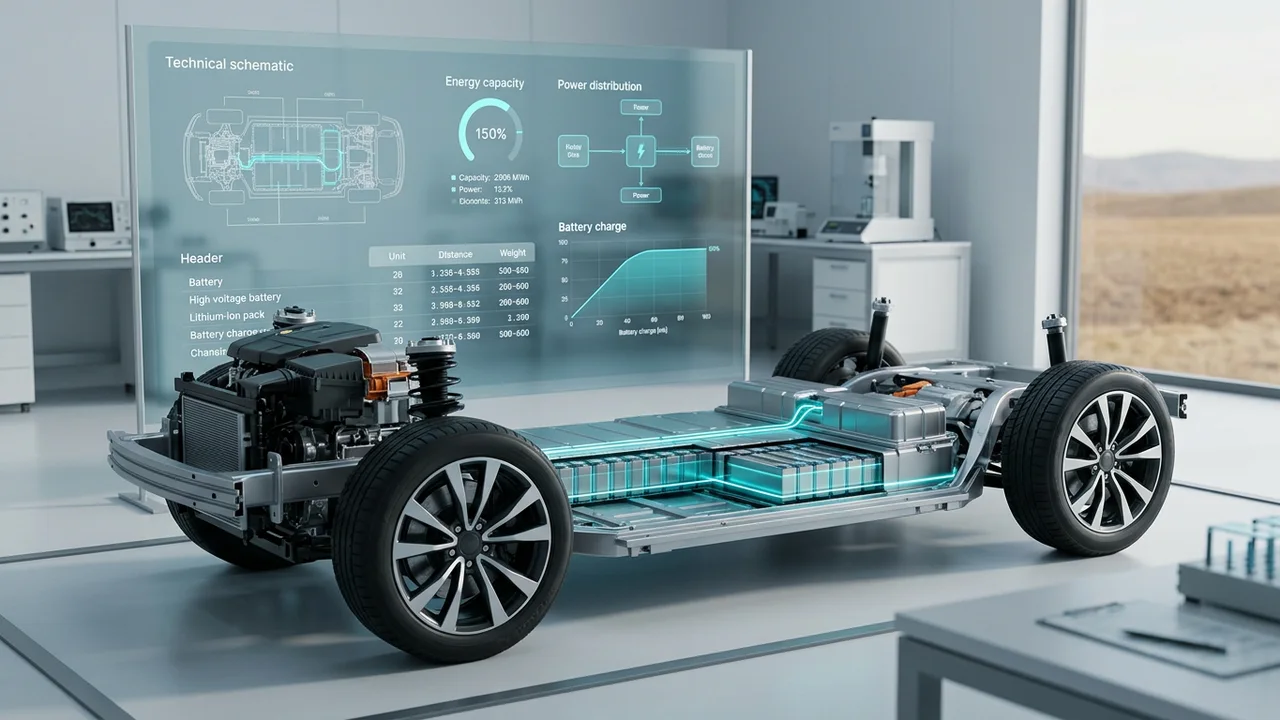
To contextualise the existing options on the market, the QuantumDrive catalogue compares 579 EV and electrified models , facilitating the analysis of how accumulator size influences the vehicle's final weight.
Charging power and on-board charger (OBC)
The on-board charger (OBC, On-Board Charger) is the converter that transforms alternating current (AC) from the plug or charging point into direct current (DC) to store it in the battery. Many models come standard with single-phase inverters limited to 3.7 kW (16 A). With modern accumulators of 20 kWh net, this limit sets the recharging time at almost 6 hours, preventing significant range recovery during short stops at workplaces or commercial areas.
To take advantage of intermediate stops, it is essential to check whether the vehicle comes standard or optionally with an OBC of 7.4 kW (single-phase at 32 A) or 11 kW three-phase, specifications documented in the publications of the Institute for Energy Diversification and Saving (IDAE). Similarly, brands such as Mercedes-Benz offer direct current (CCS Combo) charging points capable of absorbing up to 50 kW, allowing for a charge from 10% to 80% in about 25 minutes. If you need to assess the available public infrastructure, review the key criteria in our guide on what to look for before plugging into nearby charging stations (Available in Spanish).
Plan your journey with QuantumDrive, travel with peace of mind.
Discover your optimal route, taking into account charging stations and your actual range.
Actual motorway consumption with a depleted battery
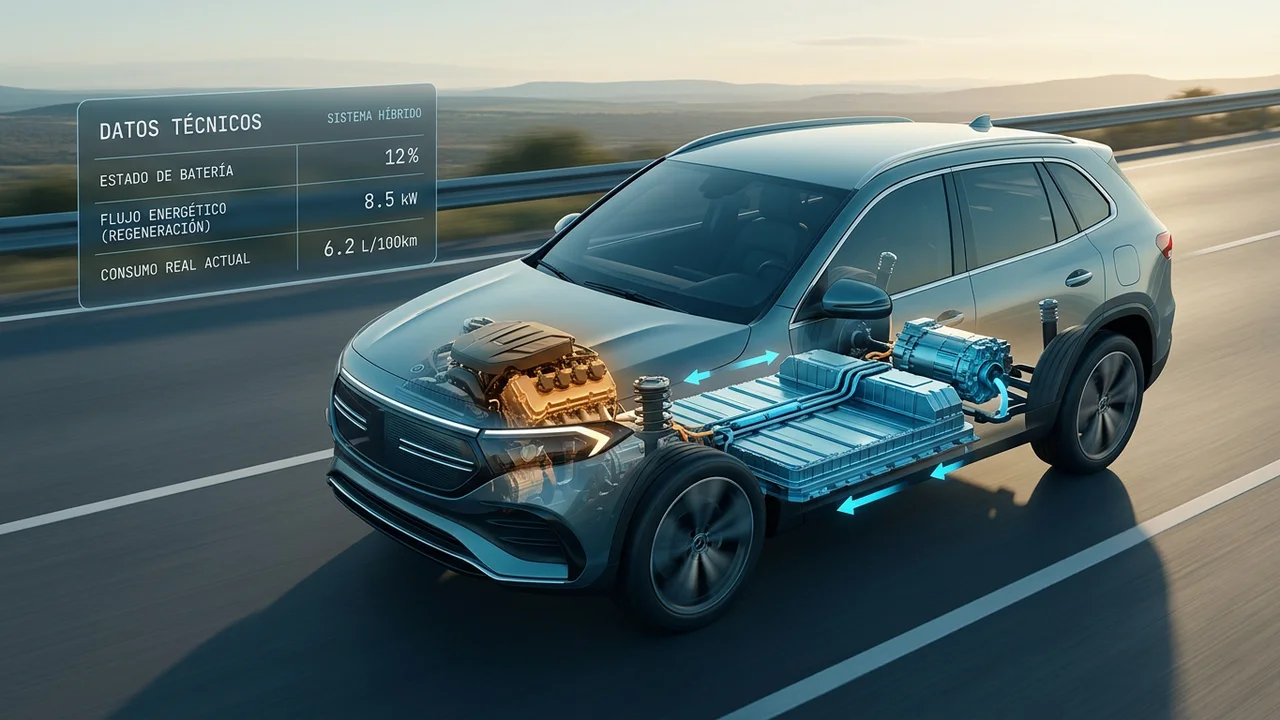
The discrepancy between the technical specifications and real-world driving is due to theUtility Factorof the WLTP cycle, a mathematical weighting that assumes almost all journeys start with a 100% battery. This formula yields homologated figures of 0.8 to 1.5 l/100 km. However, real-world measurements published by the International Council on Clean Transportation (ICCT) reveal that, when the battery is depleted, motorway consumption rises to figures between 6.5 and 9.5 l/100 km.
When the battery reaches its minimum level, the car operates in self-charging hybrid mode, relying on regenerative braking (the system that reverses the electric motor's rotation during deceleration to produce electricity and send it to the battery). However, the additional mass takes its toll: dragging between 250 and 400 kg of electrical components increases thermal consumption by 15% to 25% compared to an equivalent petrol SUV.
Dynamics, excess weight, and loss of boot space
The dual powertrain adds between 250 kg and 400 kg of excess weight compared to a pure internal combustion model, as reflected in the weight homologation sheets published in the Official State Gazette (BOE). This extra mass increases inertia in corners, lengthens emergency braking distances, and subjects the tyres to accelerated wear, requiring stiffer suspension setups to control body movements.
The toll of cargo volume
Housing the battery pack next to the rear axle necessitates relocating the fuel tank and eliminating the underfloor compartment. According to VDA measurements collected in Euro NCAPreports, a plug-in hybrid SUV loses an average of 80 to 150 litres of boot space compared to its internal combustion siblings, also making it impossible to fit a conventional-sized spare wheel.
Buying criteria for plug-in hybrid SUVs
To determine if this format suits your profile or if it's more convenient to choose a self-charging hybrid or a 100% EV model, analyse these four technical factors before signing the purchase:
| Factor evaluated | When it's advantageous | When it's not recommended | Essential technical check |
|---|---|---|---|
| Net usable capacity | Daily journeys of 40 to 80 km with charging at origin or destination. | Journeys of more than 120 km daily on the motorway without intermediate stops. | Net usable capacity (kWh) differentiated from the gross value in the specifications. |
| AC charging power | 7.4 kW or 11 kW OBC for energy recovery during urban stops of 2-3 hours. | 3.7 kW OBC if regularly relying on public daytime charging. | Maximum power supported in single-phase and three-phase AC. |
| DC rapid charging | Frequent use on journeys with short 25-minute stops using a CCS connector. | Journeys where the petrol engine handles the entire interurban trip. | Presence of a CCS Combo port and supported peak power (minimum 40-50 kW). |
| Usual charging location | Own domestic charging point with a night-time tariff (cost of 0.08 to 0.15 €/kWh). | Continuous reliance on public charging points at tariffs of 0.35 to 0.55 €/kWh. | Contracted power at home and compatibility of the charging point. |
Regarding mechanical warranties, manufacturers such as Ford cover the high-voltage battery for 8 years or 160,000 km, committing to a minimum capacity retention (SoH or State of Health, the percentage of residual health compared to original capacity) of 70% to 75%.
Related articles
Actual consumption in plug-in hybrids
Learn how to calculate the weighted cost of petrol and electricity based on your actual daily mileage and charging frequency.
Health and degradation of lithium batteries (Available in Spanish)
Factors that accelerate capacity loss in traction cells and how to check SoH before buying.
Nearby charging points: what to check (Available in Spanish)
Key aspects for evaluating public charging points: compatible connectors, per-minute or per-kWh pricing, and actual power outputs.
Actual consumption versus homologated cycle (Available in Spanish)
Understand the influence of aerodynamics, air conditioning, and motorway speed on the energy consumption of electrified vehicles.
QuantumDrive plans your route considering your actual conditions.
Discover your optimal route, taking into account charging stations and your actual range.
Frequently asked questions
How much does a plug-in hybrid SUV consume when the battery is depleted?
On the motorway at a sustained 120 km/h with a depleted battery, a PHEV SUV consumes between 6.5 and 9.5 l/100 km depending on its aerodynamic size and thermal engine. Although the system regenerates during braking, functioning like a conventional hybrid, it carries an additional weight burden of between 250 and 400 kg, which increases consumption by 15% to 25% compared to an equivalent thermal version.
Does it make sense to buy a PHEV SUV without a charging point at home?
Economically, it is not advisable. Without access to overnight home charging at off-peak rates (0.08-0.15 €/kWh), relying on the public AC network (0.30-0.45 €/kWh) or DC (>0.50 €/kWh) equals or exceeds the cost per kilometre of petrol, making it impossible to recoup the purchase premium of 4,000 to 8,000 euros compared to a conventional hybrid.
How much boot space is lost compared to thermal versions?
The reduction usually ranges between 80 and 150 litres of VDA volumetric capacity. The location of the lithium cells and the reconfiguration of the fuel tank almost always eliminate the lower false floor and completely cancel out the option of housing a standard spare wheel under the boot floor.
How long does an EV charge take to complete?
On a 2.3 kW domestic Schuko socket, a 20 kWh net battery requires between 8 and 10 hours. With a 7.4 kW wall charging point, the time decreases to about 2.5 or 3 hours. In advanced models equipped with a 50 kW CCS DC charging point, going from 10% to 80% takes about 25 minutes.
What warranty covers battery degradation in these vehicles?
The industry standard is a commercial warranty of 8 years or 160,000 kilometres. Coverage is usually activated if the maximum retained capacity (SoH) falls below 70% or 75% during this period, requiring official dealer diagnostics for verification.