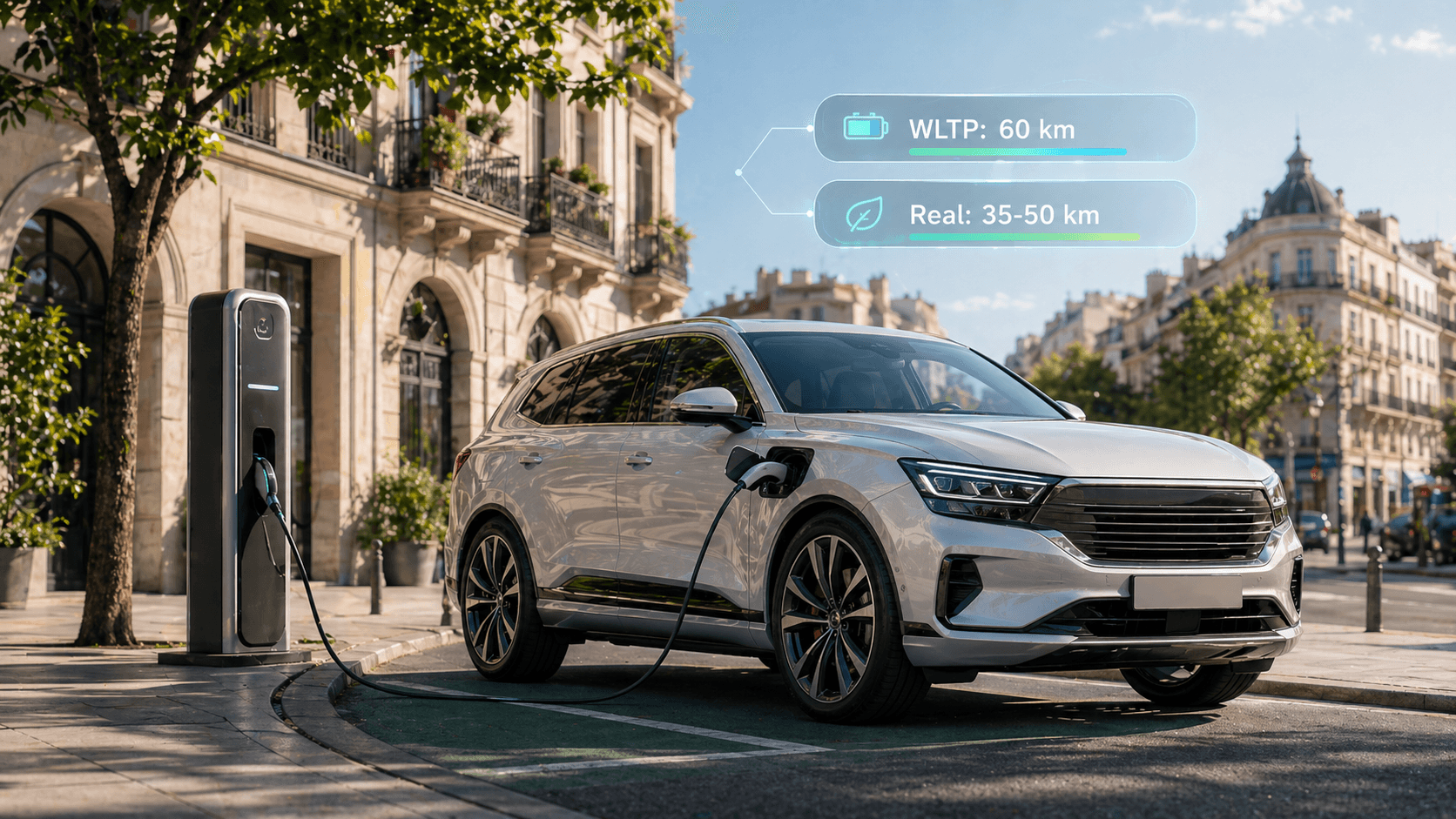
What does “real consumption” mean in a plug-in hybrid
The real consumption of a plug-in hybrid isn't just measured in litres per 100 km. A PHEV has two consumption figures: the electricity it uses when driving in EV mode and the fuel it needs when the internal combustion engine kicks in.
Therefore, the correct question isn't just “how much does it consume?”, but what percentage of your daily kilometres can you do on electric power. If you charge frequently and your journeys fall within the real electric range, petrol consumption can be very low. If you rarely plug it in, the car behaves like a heavy hybrid that doesn't make the most of its battery.
To compare this approach with a pure electric vehicle, you can read our guide on real consumption of an electric car (Available in Spanish).
How many electric km does a plug-in hybrid really do
In daily use, many plug-in hybrids typically achieve between 50% and 80% of their WLTP electric range. The range varies by model, usable battery capacity, hybrid management, temperature, speed, tyres, and driving style.
These ranges don't replace an actual measurement for your car (Available in Spanish), but they help to avoid overly optimistic expectations when looking at the technical specifications.
Indicative table: WLTP range vs real-world electric km
Use this table as a practical translation between the official figure and daily use. The values are indicative for modern PHEV passenger cars with a charged battery, correct tyre pressure, and normal driving.
| WLTP electric range | City / low speed | Real-world mixed use | Motorway / cold weather | Practical reading |
|---|---|---|---|---|
| 40-50 km | 30-40 km | 25-35 km | 20-30 km | Suitable for short urban journeys if you charge almost daily. |
| 60-70 km | 45-55 km | 35-50 km | 28-40 km | Good balance for daily suburban commutes. |
| 80-100 km | 65-85 km | 55-75 km | 40-60 km | Can cover many full days without using petrol. |
How to estimate your real electric km with a simple formula
For a quick estimate, multiply the WLTP electric range by a real-world usage factor based on your main scenario.
Example: 60 WLTP km × 0.70 = 42 estimated real electric km.
| Scenario | Indicative factor | Example with 60 WLTP km |
|---|---|---|
| Mild city | 0.75-0.90 | 45-54 km |
| Normal mixed use | 0.60-0.80 | 36-48 km |
| Motorway | 0.50-0.70 | 30-42 km |
| Motorway + cold weather | 0.40-0.60 | 24-36 km |
The formula isn't meant to be exact to the kilometre. It serves to help you make better decisions: to know if your daily journey fits within electric mode, if you need to charge at your destination, or if a PHEV suits your routine.
Why WLTP and real-world use don't match
The WLTP cycle allows models to be compared under standardised conditions, but it doesn't reproduce all real-world situations: sustained motorway driving, winter, wind, gradients, air conditioning, or fast driving.
In PHEVs, there's also a crucial variable: charging frequency. The International Council on Clean Transportation has documented that the real consumption and emissions of plug-in hybrids can deviate significantly from homologation when they are rarely charged or cover many kilometres with the internal combustion engine. The European Commission has also promoted methodological adjustments to better reflect the real-world use of this type of vehicle.
Furthermore, a policy brief by Fraunhofer ISI, Öko-Institut and ifeu published in 2026, based on the evaluation of around one million PHEVs, concludes that the real energy consumption of plug-in hybrids is significantly higher than observed in homologation procedures.
Charging frequency
If you don't charge every day or almost every day, electric mode ceases to be the main driver and fuel consumption increases.
Speed
On the motorway, electricity consumption increases and the battery depletes faster than in the city or in flowing traffic.
Temperature
Cold weather negatively impacts the battery, heating, and efficiency. Extreme heat can also increase energy consumption.
Terrain and load
Uphill climbs, extra weight, and incorrectly inflated tyres reduce the available electric range.
Three practical cases to understand it better
25 km daily in the city
This is the ideal scenario. If you charge at home or at work, many PHEVs can do almost the entire weekly journey on electric power.
55 km daily with motorway driving
A PHEV with 60-70 km WLTP range can cover a good part of the journey, but perhaps not all if there are sections at 100-120 km/h.
120 km daily without a charging point
This is the least favourable scenario. If you charge infrequently, you'll drive many kilometres as a conventional hybrid with more weight.
For which profile does a plug-in hybrid make sense?
A PHEV isn't good or bad by definition. It fits better or worse depending on your access to charging and your travel patterns.
| Usage profile | PHEV fit | QuantumDrive Recommendation |
|---|---|---|
| Short daily commutes + home charging | Very high | Prioritises real electric range and charging cost. |
| Mixed use + charging at work or destination | High | Reserve battery for city and urban access. |
| Frequent long journeys + infrequent charging | Medium-low | Compare with conventional hybrid or pure electric depending on route. |
| No regular charging point | Low | Don't buy solely based on the WLTP figure; calculate real usage first. |
How to maximise your PHEV's electric kilometres
The improvement doesn't come from a single trick, but from using the car with energy logic.
Charge every day you can
A plug-in hybrid is designed to be plugged in frequently. Even if you don't reach 100%, every charge adds useful electric kilometres.
Save battery for the city
Electric mode usually provides more benefit at low speeds, in traffic jams, urban access, and low emission zones.
Avoid harsh acceleration
In some models, pressing hard on the accelerator activates the internal combustion engine even if battery is still available.
Pre-condition while charging
Pre-heating or cooling before setting off reduces energy consumption for the first few kilometres, especially in winter and summer.
Plan your electric journeys better
QuantumDrive helps you understand consumption, range, and routes with more context than a fixed WLTP figure. Check how your car fits with real journeys and make decisions with practical data.
Try QuantumDriveQuick checklist to know if you're using your PHEV correctly
- You charge it at least 4-5 times a week.
- Your daily journeys fit within the real electric range, not just WLTP.
- You reserve battery for the city on mixed routes.
- You avoid acceleration that unnecessarily activates the internal combustion engine.
- You measure kWh recharged, litres refuelled, and kilometres travelled separately.
- You compare your result with your actual usage, not with an ideal catalogue figure.
Common mistakes when interpreting the real consumption of a PHEV
Only looking at official litres
In a PHEV, consumption depends heavily on how much you charge and how many kilometres you drive electrically.
Not plugging it in daily
An unplugged plug-in hybrid loses its main advantage over a conventional hybrid.
Using up all the battery on the motorway
On mixed routes, it can be more efficient to save energy for city driving, traffic jams, and slow sections.
Comparing it incorrectly with a pure electric vehicle
A PHEV is a useful transitional solution for certain profiles. A pure electric vehicle is usually more efficient if you can charge and cover your routes.
Recommended readings to further refine your decision
QuantumDrive guides to move from catalogue figures to real decisions on consumption, range, grants, and planning.
Frequently asked questions about real consumption of plug-in hybrids
How many electric kilometres does a plug-in hybrid actually do?
It depends on the model and usage, but many PHEVs achieve approximately 50% to 80% of their WLTP electric range. In the city and temperate climates, they get closer to the official figure; on the motorway, in cold weather, or with fast driving, they deviate more.
Why does my PHEV start the petrol engine if it still has battery?
This can happen due to strong acceleration, low temperature, heating demand, automatic vehicle mode, mechanical protection, or the need for additional power. Each manufacturer manages the transition between electric and internal combustion engines differently.
Does a PHEV make sense if I can't charge at home?
It makes less sense. It can be useful if you charge at work or at your destination, but if you almost always rely on the internal combustion engine, you lose a good part of the savings and efficiency that justify a plug-in hybrid.
Is it better to always use electric mode?
Not necessarily. For short urban journeys, it's usually best. On long routes with motorway and city driving, it can be more efficient to save some of the battery for low-speed sections.
Does a PHEV consume more when the battery runs out?
When the usable battery runs low, the car operates as a conventional hybrid. It can still recover energy, but it carries more weight than an equivalent internal combustion vehicle, so consumption can increase if the electric part is not utilised.
How can I measure my real PHEV consumption?
For two or three weeks, record total kilometres, recharges, kWh added, and litres refuelled. Separate urban, mixed, and motorway journeys. This way you'll see how many kilometres you actually drive electrically and how much fuel you need.