
Specifications and Total Cost
Accessing the DGT's ZERO emissions badge with the tightest budget usually focuses attention on the list price. However, in a plug-in hybrid (PHEV), the internal charger, battery capacity, and cost per kilometre determine whether the purchase is worthwhile compared to a combustion engine or a pure EV.
Quick Summary
- Reference models by price: The MG HS PHEV leads the market entry from €24,540 with campaigns and financing (list RRP without discounts of ~€36,000), while alternatives such as the BYD Seal U DM-i start from €29,990 in its Boost version.
- Modern batteries: The new affordable generation uses gross battery packs of 18.3 to 21.4 kWh, homologating between 70 and 100 km in the WLTP cycle, far from the residual 8 to 10 kWh batteries of previous years.
- Legal framework of the label: To obtain the Zero Emissions badge, the vehicle must register a minimum of 40 km of range in purely electric mode according to the DGT's Zero Emissions environmental badge criteria.
- Home energy cost: Recharging at home during off-peak hours allows for 100 km of driving for €2.85–€3.30 (at €0.15/kWh), compared to the €9.50–€10.50 required for exclusively petrol driving. Find out in detail the actual consumption of a plug-in hybrid and its real electric kilometres.
- Essential condition: Without a garage with a domestic plug, the battery's overweight of 250 to 400 kg increases thermal consumption to 6.8–7.5 l/100 km, negating profitability compared to a conventional hybrid.
What is currently the cheapest plug-in hybrid in Spain?
The market for affordable plug-in hybrids in Spain has undergone a competitive shift. Entry-level offerings are no longer restricted to small adapted city cars with minimal batteries, but rather to family SUVs that leverage economies of scale in lithium iron phosphate (LFP) cells.
The most accessible model by financed purchase price is the MG HS PHEV, starting from €24,540 with commercial promotions and linked financing, compared to an official list price of approximately €36,000. With a gross 21.4 kWh battery, it homologates 100 km in the WLTP cycle. Its direct rival by budget in the SUV category is the BYD Seal U DM-i (Boost version), available from €29,990 with promotional campaigns (official RRP of €38,500), which integrates 18.3 kWh and homologates 80 electric km.
Both cars are comfortably below the price cap established in public incentive programmes for sustainable mobility, allowing access to current state aid regulated by the Auto+ Programme (RD 609/2026), as well as the state income tax deduction of up to €3,000 for the purchase of an electrified vehicle.
Evaluation criterion: QuantumDrive's catalogue compares 579 EV models. When analysing the cost of a plug-in hybrid, the determining factor is not the advertised price in the configurator, but the cost differential per kilometre compared to an equivalent combustion car over 100,000 km.
The invisible costs: small print, financing, and EV charging point
The promotional price in dealerships often hides associated costs that substantially alter the total cost of ownership (TCO). Anyone evaluating a low-priced plug-in hybrid must break down four factors before committing their budget.
1. Financing conditions and fees
The €3,000 to €6,000 discount advertised in campaigns requires financing large amounts with nominal interest rates (TIN) ranging between 7.5% and 9.5%. In contracts of 48 to 72 months, interest and opening fees add between €4,000 and €7,000 to the total cost, reducing or negating the initial advantage over outright purchase.
2. Installation of the home EV charging point
For a PHEV to be economically viable, home charging is essential. The installation of a 3.7 kW or 7.4 kW wallbox EV charger in a single-family or communal garage costs between €1,000 and €1,800, depending on the distance to the meter box and the necessary conduits under low-voltage technical regulations.
3. Taxation of public aid
State subsidies do not constitute an automatic discount on the invoice (unless contractually advanced by the financial institution) and must be taxed in income tax as a capital gain. Depending on the buyer's tax bracket, between 19% and 47% of the subsidy amount will be returned to the Treasury in the income tax declaration for the following year.
4. Dual maintenance plan
Unlike a 100% EV, a PHEV maintains the mechanical operations of a combustion engine: oil, filters, spark plugs, and brake fluid, adding the checking of high-voltage circuits. You can consult the impact on cell longevity in our analysis on lithium batteries in EVs, health, and degradation (Available in Spanish).
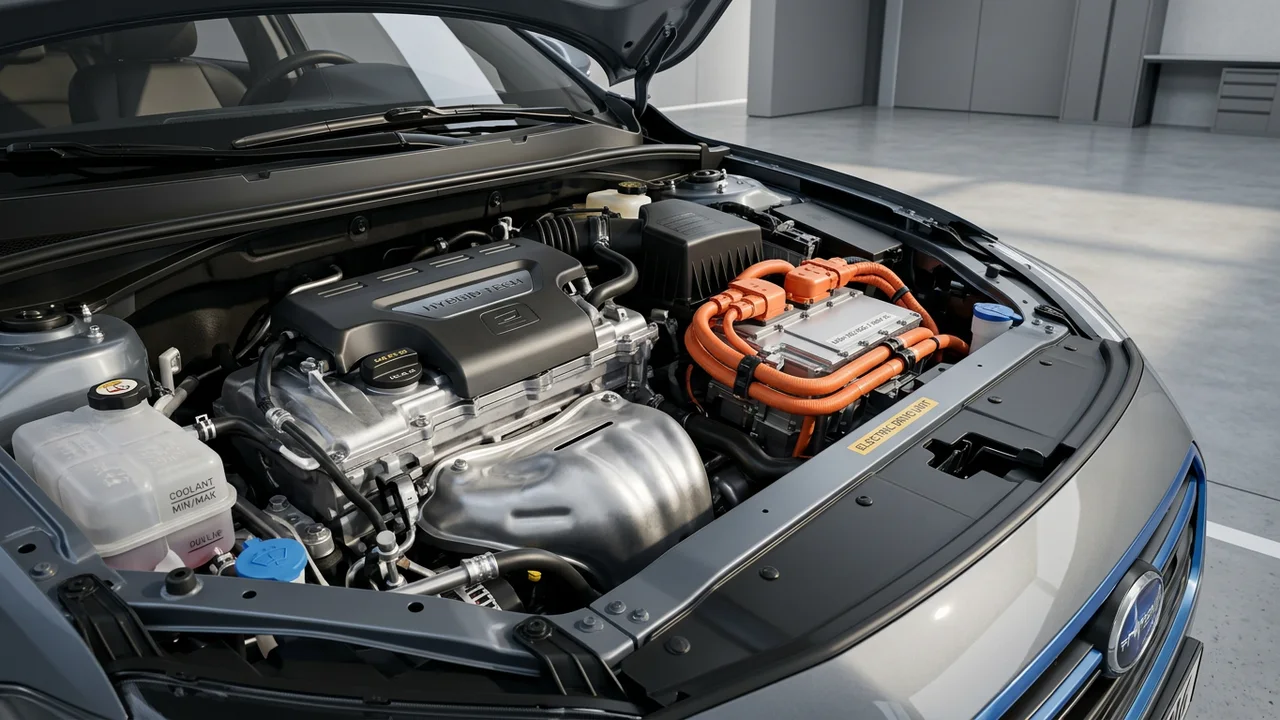
Technical comparison: entry-level models head-to-head
To evaluate what the entry-level segment delivers for every euro invested, we contrast the technical data of the two most affordable models against the standard of an equivalent petrol or mild-hybrid compact car.
| Vehicle and version | Access price with campaign | Battery capacity (gross / usable) | Approved range (WLTP) | Maximum power of the internal charger (OBC) | Petrol consumption with depleted battery |
|---|---|---|---|---|---|
| MG HS PHEV | From €24,540 (RRP ~€36,000) | 21.4 kWh / ~18.5 kWh | 100 km | 3.7 kW in alternating current (single-phase, ~5.5 h) | 6.8 – 7.5 l/100 km |
| BYD Seal U DM-i (Boost) | From €29,990 (RRP ~€38,500) | 18.3 kWh / ~16.0 kWh | 80 km | 11 kW in AC (~2 h) and 18 kW in DC (~35 min) | 6.2 – 6.9 l/100 km |
| Equivalent petrol car / MHEV | €23,000 – €26,000 | Not applicable (no traction battery) | 0 km (100% electric mode) | Not applicable (not plug-in) | 5.8 – 6.4 l/100 km |
The most notable technical difference lies in the power of the on-board charger (OBC). The MG HS PHEV is limited to 3.7 kW in alternating current, requiring between 5 and 6 hours for a full charge. In contrast, the BYD Seal U supports up to 11 kW in alternating current and includes direct current (DC) charging at 18 kW, which allows the battery to be replenished at public charging points while shopping or running errands.
Electromobility could be your best investment.
Discover how much you would save on fuel by purchasing an EV.
When does a cheap PHEV pay off compared to a petrol or a pure EV?
To determine if it is worthwhile to bear the additional purchase cost of a plug-in hybrid compared to a conventional hybrid (HEV) or an equivalent petrol car, it is necessary to calculate the electric kilometres needed to offset the price difference.
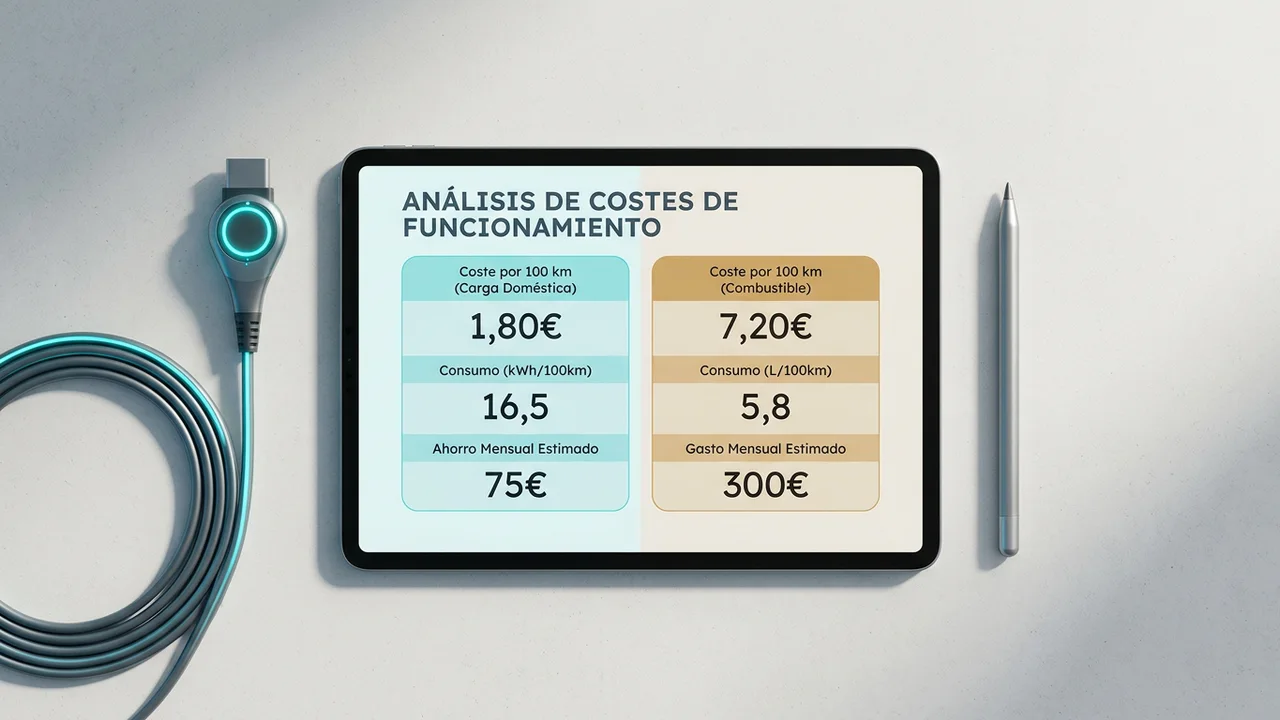
Based on the hourly prices of the PVPC energy tariff or free market tariffs geared towards EVs, the average cost during off-peak periods is around €0.15/kWh. With an average consumption of 20 kWh/100 km, driving in electric mode costs approximately €3.00/100 km. Meanwhile, an equivalent internal combustion engine with an average consumption of 6.5 l/100 km and petrol at €1.60/l requires €10.40/100 km. The gross saving is €7.40 for every 100 km driven in zero-emission mode.
Formula for amortising the additional purchase cost
The distance required to amortise the additional purchase price depends on the proportion of journeys covered in purely electric mode:
Break-even km = Real price premium (€) / [ (Petrol cost per 100 km − Electricity cost per 100 km) / 100 × % of km driven electric ]
Practical example for an additional cost of €4,000:
- Actual purchase difference: €4,000 (including home charger installation).
- Savings in pure electric mode: €7.40/100 km.
- If the driver covers 75% of their kilometres in electric mode (daily recharging and urban journeys): the effective saving is €5.55 per 100 total km.
- Result: it takes 72,072 km to recoup the investment (approximately 4.8 years at a rate of 15,000 km per year).
- If the driver only drives in electric mode the 35% of the kilometres (frequent motorway trips without recharging): the savings drop to €2.59/100 km, extending the payback period to 154,440 km (more than 10 years).
Decision rule: If you cannot complete at least 60% of your annual journeys using battery power from home charging, a classic self-charging hybrid (non-plug-in) or an efficient diesel car will prove more economical over a 5-year period. Also, discover the comparison of real-world range vs. WLTP and why consumption increases on motorways.
Limitations of affordable PHEVs: charging power and weight
To keep access tariffs low, manufacturers apply technical solutions that directly influence daily use. Identifying these limitations prevents frustration after delivery.
1. Slow charging and absence of direct current (DC) charging
Most affordable plug-in hybrids do not feature CCS Combo rapid charging connectors. They are equipped with internal alternating current chargers limited to 3.7 kW or 7.4 kW. Stopping at a public high-power EV charging point during a journey is unfeasible: the battery will require between 3 and 5 hours to fully charge, forcing interurban journeys to be made using the petrol engine.
2. Overweight and consumption with low State of Charge (SoC)
The high-voltage battery pack (140–220 kg), electric motor, and inverter add considerable excess weight. When the state of charge (technically SoC, short for State of Charge, the percentage of energy left in the battery) drops to the minimum reserve, the vehicle runs as a conventional hybrid while carrying a mass of more than 1,800 kg. On motorways at 120 km/h, petrol consumption typically ranges between 6.8 and 8.0 l/100 km.
3. Reduced boot capacity
In platforms shared with internal combustion engine vehicles, the location of the battery pack under the boot floor reduces usable volume by 80 to 130 litres compared to petrol or diesel variants, usually eliminating the false floor for the spare wheel or charging cables.
Checklist before buying an accessible PHEV
- Check if the vehicle includes the Mode 3 cable (Type 2 - Mennekes) as standard or if it only provides the emergency Schuko charger for a domestic socket.
- Verify the maximum power of the onboard charger (OBC): a system limited to 3.7 kW will double charging times at semi-rapid destination EV charging points.
- Check the boot with the false floor in place to confirm that the remaining space covers typical family luggage.
- Demand the full financial breakdown: compare the total financed cost with interest against the cash price, adding the EV charging point installation.
Related articles on specifications and efficiency
Real-world consumption of a plug-in hybrid: electric miles
Analyses petrol consumption per 100 km when the battery is depleted and how official motorway figures vary. Read real-world consumption guide.
Real-world range vs. WLTP cycle
Understand the speed, temperature, and climate control factors that reduce the approved range of any battery. See WLTP range analysis.
Health and degradation in lithium batteries
Learn about the thermal factors and charging cycles that affect the lifespan of batteries in electrified vehicles. Consult battery degradation (Available in Spanish).
Frequently Asked Questions
What is the cheapest plug-in hybrid you can buy in Spain?
The MG HS PHEV stands as the most accessible family option, with promotional rates starting around €24,540 linked to financing. As an alternative in the compact SUV segment, the BYD Seal U DM-i starts from approximately €29,990 in Boost trim. Catalogue prices without discounts range between €36,000 and €38,500.
Is a cheap plug-in hybrid worthwhile if I don't have my own garage for charging?
No. Without home charging on a night-time tariff (~€0.12–€0.18/kWh), charging at public charging points costs between €0.40 and €0.60/kWh, increasing the cost per 100 km to around €8.00–€12.00. If used without charging, petrol consumption rises to 7.0–8.0 l/100 km due to the battery's weight, making it more expensive than a conventional hybrid without a plug.
Do all affordable plug-in hybrids have the DGT's CERO label?
Yes, provided their approved range in exclusively electric mode is at least 40 km according to the WLTP cycle. Recently launched affordable models approve between 70 km and 100 km of electric range, thus comfortably exceeding the legal requirement and obtaining the DGT's Zero Emissions badge.
How long does an affordable plug-in hybrid take to charge?
It depends on the battery capacity and the on-board charger. With a battery of about 18 to 21 kWh and a 3.7 kW charger in a reinforced socket or basic wallbox, a full charge takes between 5 and 6 hours. With a 7.4 kW charger, the time is reduced to about 2.5 or 3 hours.
Can long road trips be made using only the petrol engine?
Yes, that is the functional advantage of the hybrid system. Once the battery's energy is depleted, the vehicle operates like a classic self-charging hybrid, regenerating energy during braking and descents. The driver can refuel with petrol at any service station without needing to stop to recharge electricity.
QuantumDrive plans your EV route considering your real-world conditions.
Discover your optimal EV route taking into account charging points and your real-world range.