
EV Travel and Route Planner
Road-tripping in an EV requires method, not improvisation. Learn how to calculate real consumption on motorways, synchronise mandatory breaks with the optimal charging window, and select reliable charging points to avoid unnecessary waits.
Quick Summary
- Depart at 100% from origin: Take advantage of overnight domestic slow charging before setting off; on the road, keep recharges between 10% and 80% SoC (State of Charge or percentage charge status).
- Stops every 200–250 km: Coincide 18 to 30-minute sessions with the physiological breaks recommended by the Dirección General de Tráfico (DGT) every 2 hours of driving.
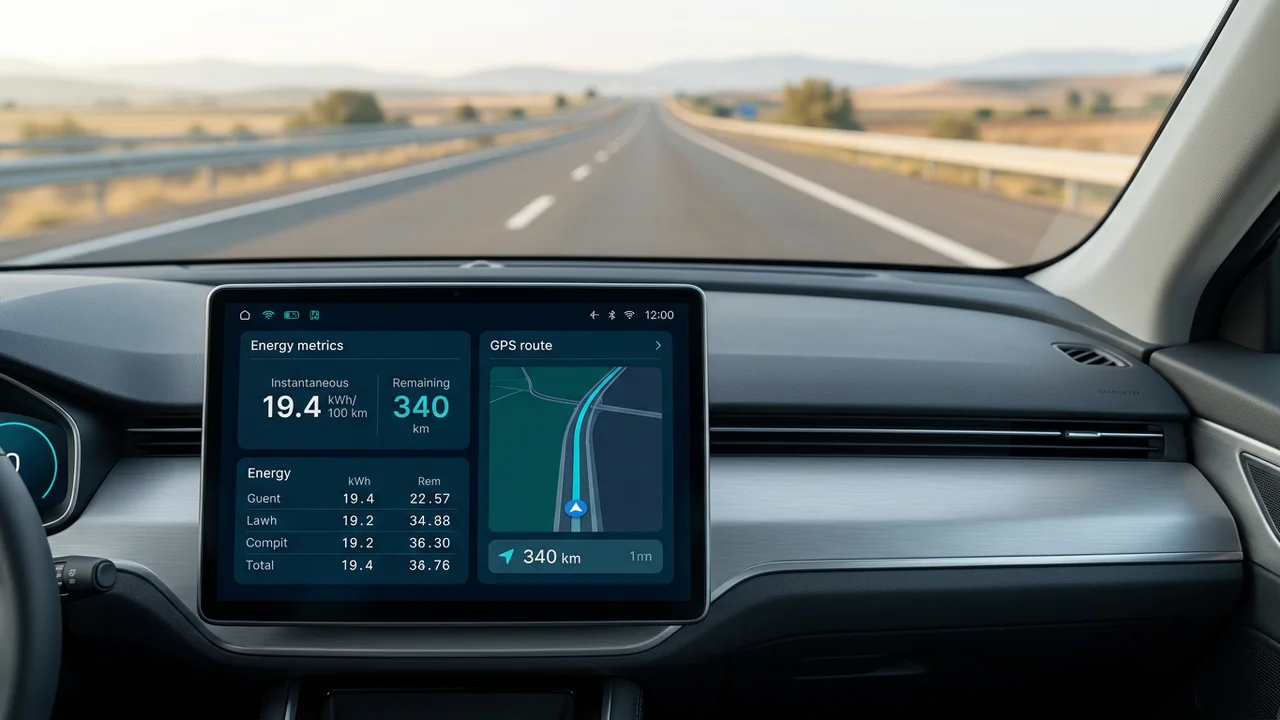
- Motorway consumption adjustment: At a constant 120 km/h, the vehicle consumes between 15% and 25% more than its combined homologation, usually between 18 and 22 kWh/100 km.
- Thermal preconditioning: Enter the charging station as a destination in the satnav so that the battery reaches its maximum performance temperature (25°C to 35°C) before plugging in.
- Essential Plan B: Select charging stations with multiple charging points and have a backup charger planned between 15 and 30 km away to avoid unforeseen events if charging posts are out of service.
Real consumption at 120 km/h: why the homologation figure is not useful
The main mistake when planning a long journey is to project stages using the homologated range under the Worldwide Harmonised Light Vehicle Test Procedure (WLTP cycle) as a reference. The official procedure weights urban and peri-urban sections at low average speeds, where regenerative braking recovers energy and aerodynamic resistance is moderate.
At sustained cruising speed on motorways (120 km/h), air resistance increases quadratically, leading to an overconsumption of 15% to 25% compared to the homologated combined figure, as reported by the efficiency analyses of the Institute for Energy Diversification and Saving (IDAE). If you want to delve deeper into how speed affects route estimation, you can consult our guide on real range versus WLTP homologation on motorways or compare your figures with the QuantumDrive real range calculator.
Practical road estimation formula: To calculate reliably, take the WLTP homologated consumption and multiply it by a factor of 1.18 on flat terrain and at 20°C. If the temperature drops below 5°C or you face prolonged gradients, raise the correction factor to 1.28.
63% of routes planned with QuantumDrive in the last year exceeded 300 km, and 35% exceeded 500 km. This shows that typical interurban journeys in Spain require planning with realistic consumption of between 18 and 22 kWh/100 km to avoid exhausting the usable reserve.
The optimal charging window: why stop at 80% battery
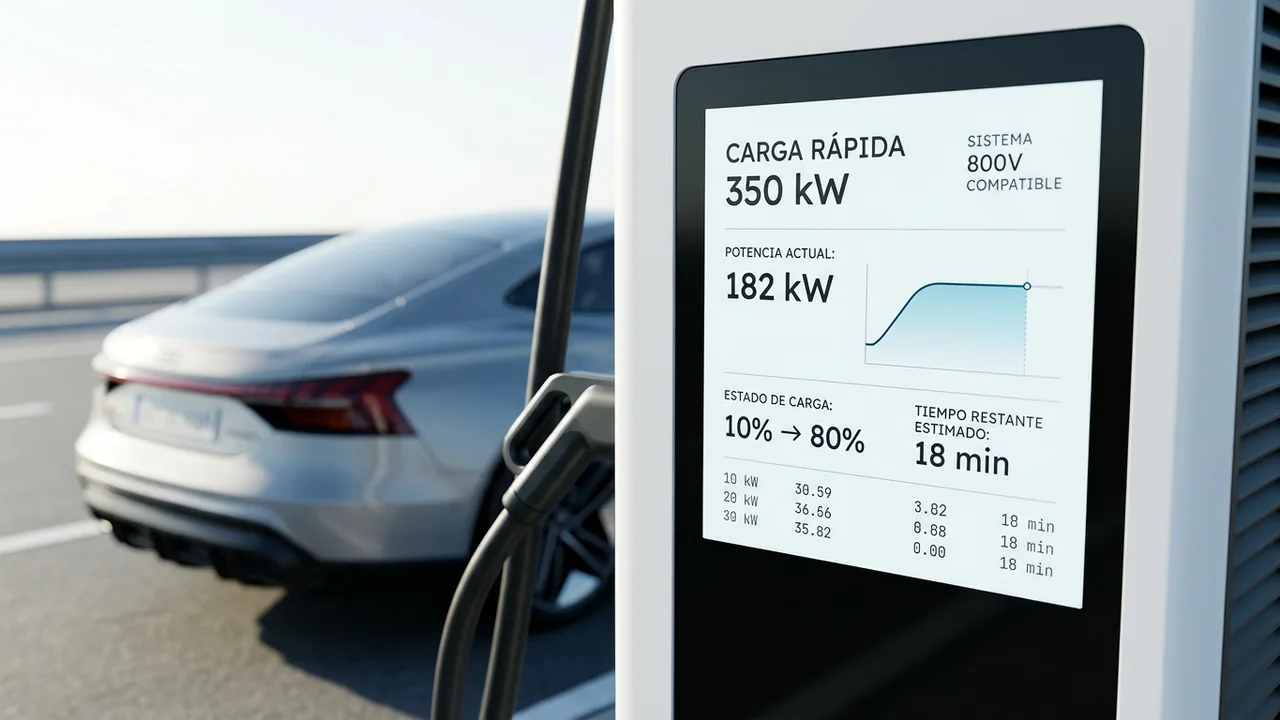
When recharging on the motorway, the determining factor is not the net battery capacity, but its charging curve (the evolution of admissible power according to the fill level). In direct current (DC), the battery's thermal and electrical management system (BMS) modulates the kilowatts received. Peak power is generally delivered between 10% and 50% SoC; upon reaching 80%, the BMS drastically reduces power (often below 40 kW) to protect the cells from overheating and chemical degradation.
Filling from 80% to 100% at a high-power charging station can take the same number of minutes as going from 10% to 80%. To learn in detail how to manage power peaks on long journeys, review the guidelines on how to optimise rapid charging on road trips.
The role of thermal preconditioning
Lithium-ion cells perform at their maximum absorption rate when they are between 25°C and 35°C. If you access a high-power charger in winter without having activated preconditioning from the satnav, the cold battery will limit delivery to 40 or 50 kW for the first 15 minutes, extending the stop by up to 30%.
Plan with QuantumDrive, travel with peace of mind.
Discover your optimal route taking into account charging points and your real range.
Types of charging points on the road and estimated times
To avoid unnecessary time loss, it is advisable to segment the charging infrastructure according to the actual power delivery and the ideal stopping time during the itinerary:
| Charging Point Type | Typical Power | Time to recover 200 km (approx. 38 kWh) | Recommended Use on Journey |
|---|---|---|---|
| AC Semi-Rapid (Three-Phase) | 11 – 22 kW | 2 h 00 min – 3 h 30 min | Exclusive destination charging (hotels, overnight stays or sightseeing). |
| DC Rapid | 50 kW | 40 – 50 min | Long stops coinciding with full midday meals. |
| DC High Power (HPC) | 150 – 350 kW | 12 – 22 min | Standard technical stop on the motorway (coffee, toilets and short break). |
Technical data from the automotive market indicates that, in vehicles with 400 V or 800 V architectures, recovering from 10% to 80% at HPC charging points takes between 18 and 30 minutes. This rollout responds to the community requirements of the Alternative Fuels Infrastructure Regulation (AFIR), which establishes the installation of charging points of at least 150 kW every 60 km on the Trans-European Core Network.
Network status in Spain and choosing alternative charging points
Although trunk corridors have increasing coverage, effective availability requires checking charging stations before arrival. According to the electromobility barometer from the employers' association ANFAC, Spain has 6,651 operational high-power charging points (≥ 150 kW), but records 17,965 installed charging points that are non-operational or awaiting connection to the electricity distribution network, representing 23.6% of the total installed infrastructure.
Given this unavailability rate, the fundamental recommendation is to avoid charging stations with a single charging point. It is advisable to prioritise charging hubs with four or more charging points from operators such as Zunder, Ionity, Iberdrola or high-power chargers open to multiple brands, where a temporary fault in one cable will not block your progress.
Safety margin criterion: Arrive at each main charging station with at least 10% or 15% battery remaining. This reserve energy will give you between 25 and 40 km to divert to a secondary charging station if the selected point experiences power cuts or unexpected queues.
Journey budget: how much does it cost to travel 500 km?
The total budget for a journey largely depends on the starting point. While domestic charging during off-peak hours usually costs around €0.08–0.12/kWh, the average price without subscriptions at ultra-rapid public DC charging points ranges between €0.48/kWh and €0.66/kWh.
Cost calculation for a 500 km journey (Average car)
Based on an average motorway consumption of 19 kWh/100 km at 120 km/h, travelling 500 km requires approximately 95 net kWh of energy:
- Full initial charge at home (100%): 60 kWh at a domestic off-peak price of €0.10/kWh amounts to €6.00.
- Rapid charging on the motorway during the journey: An additional 35 kWh (plus 3 kWh for thermal conversion losses, total 38 kWh) at an average rate of €0.55/kWh equates to €20.90.
- Total energy cost of the journey: €26.90 (about €5.38 per 100 km).
For reference, an equivalent internal combustion car with an average motorway consumption of 6.5 l/100 km of petrol (at €1.65/litre) would require 32.5 litres, reaching a cost of €53.62. Leaving home at 100% charge can cut the total fuel expense by approximately half.
Technical checklist before starting the journey
Before setting off, check these five key aspects to ensure a continuous and smooth journey:
- 100% charge at origin scheduled: Adjust the charge limit to 100% at your home charging point the night before, so the car finishes charging shortly before you leave.
- Tyre pressure checked: A pressure 0.2 bar below the specified level with a loaded boot increases friction and can raise consumption by up to 3%.
- Payment methods and interoperability: Download and register your payment details in the apps of the networks present on your itinerary, and carry a physical RFID card in case the charging station is located in an area with poor mobile coverage.
- Live status check: A few minutes before your stop, check that the planned charging points are shown as free and in service.
- Pre-conditioning while plugged in: Pre-condition the cabin while the vehicle is still plugged into the charging point to avoid reducing range during the first hour of the journey.
Frequently asked questions about EV trips
How long does it take to charge during a 500 km journey?
Starting with a 100% battery, an average EV typically requires one or two technical stops of 18 to 25 minutes at high-power charging points (≥ 150 kW). The additional time compared to a combustion vehicle is around 30 to 45 minutes, which fits with recommended driving breaks.
Why is it not advisable to charge the battery to 100% at a motorway charging station?
Because the battery management system (BMS) significantly reduces power from 80% to mitigate overheating. Replenishing the remaining 20% can extend the stop by more than an additional 30 or 40 minutes at low power, unnecessarily increasing journey times.
How does the use of air conditioning or heating affect range on a journey?
In summer, air conditioning typically requires between 1 and 2 kW of power, reducing range by 3% to 6%. In winter, resistance heating without a heat pump can draw between 3 and 5 kW, shortening range by 15% to 20% in low ambient temperatures.
What happens if I arrive at a charger and all the sockets are occupied or out of service?
If you have maintained a 10% to 15% SoC reserve, you will have between 25 and 40 km of safety range to travel to the alternative charging station you identified during route planning.
Is it mandatory to have specific RFID cards for charging in Spain?
It is not mandatory. The European AFIR regulation stipulates direct payment via a POS terminal with a bank card at newly installed rapid charging stations, and most networks operate through their respective mobile apps. Having a physical RFID card is still good practice in areas with poor mobile coverage.
Further reading to optimise your journeys
Best EV route planners
Recommended predictive tools and algorithms for calculating consumption, considering gradients, charging stops, and wind.
What to check at a charger before plugging in (Available in Spanish)
Technical inspection criteria: effective power, CCS2 connector compatibility, and payment methods at public charging points.
Practical route: Madrid to Valencia in an EV (Available in Spanish)
A step-by-step breakdown of recommended stops, consumption at the Contreras pass, and ultra-rapid charging stations on the A-3 motorway.
Start planning your routes with QuantumDrive.
Discover your optimal route, considering charging points and your real-world range.