
Technical Travel Guide
On a long motorway journey, stopping time doesn't depend on filling the battery to 100%, but on taking advantage of the peak power window between 10% and 80%. Understanding the charging curve and thermal management makes the difference between a 20-minute break and a frustrating wait of almost an hour.
Quick summary
- Optimal window 10%–80%: The standard rapid charging stop on a journey lasts between 18 and 32 minutes in cars with 400 V architecture, and just 15 to 18 minutes on 800 V platforms.
- The 80% wall: Upon exceeding 80% State of Charge (SoC, State of Charge), the Battery Management System (BMS) drastically reduces power from 150–250 kW to less than 35–45 kW to prevent overheating. Charging from 80% to 100% requires an extra 28 to 40 minutes, almost the same as going from 10% to 80%.
- Infrastructure by law in corridors: The European AFIR Regulation (EU 2023/1804) mandates rapid charging stations with a minimum of 150 kW every 60 km on the main trans-European network (TEN-T).
- Thermal penalty for cold cells: Plugging in with the battery below 15 °C without prior preheating adds an extra 15 to 25 minutes of waiting by limiting the input power.
- Cost and direct payment: Ultra-rapid charging without subscriptions ranges from €0.54/kWh to €0.66/kWh in Spain (around €22–€26 to gain 250 km of motorway range), and from 2024, payment by bank card or POS terminal is mandatory without needing to install apps.
How long does it take to charge an EV on a journey? The real numbers
On a conventional long-distance journey (400 to 600 km), a current EV with a net battery capacity of between 60 and 77 kWh usually requires a single intermediate stop of 20 to 30 minutes, or two very brief 15-minute breaks. This interval naturally fits with the recommended roadside rest times by the DGT, which advises stopping for at least 20 minutes every two hours or 200 kilometres of driving.
The misconception that EV travel means spending hours stopped comes from extrapolating slow domestic AC charging (at 3.7 kW or 7.4 kW) to motorway chargers. On the road, only direct current (DC) is used, supplied by high-power stations that inject energy directly into the cells without passing through the car's on-board inverter. If you want to evaluate the difference between the homologated figure and actual motorway consumption before planning your stops, consult our real range calculator for your EV.
Verified data: 63% of routes planned with QuantumDrive in the last year exceeded 300 km, and 35% exceeded 500 km. Long-distance journeys are a common operation for the current vehicle fleet and are completed efficiently as long as you don't try to fill the battery as if it were a traditional fuel tank.
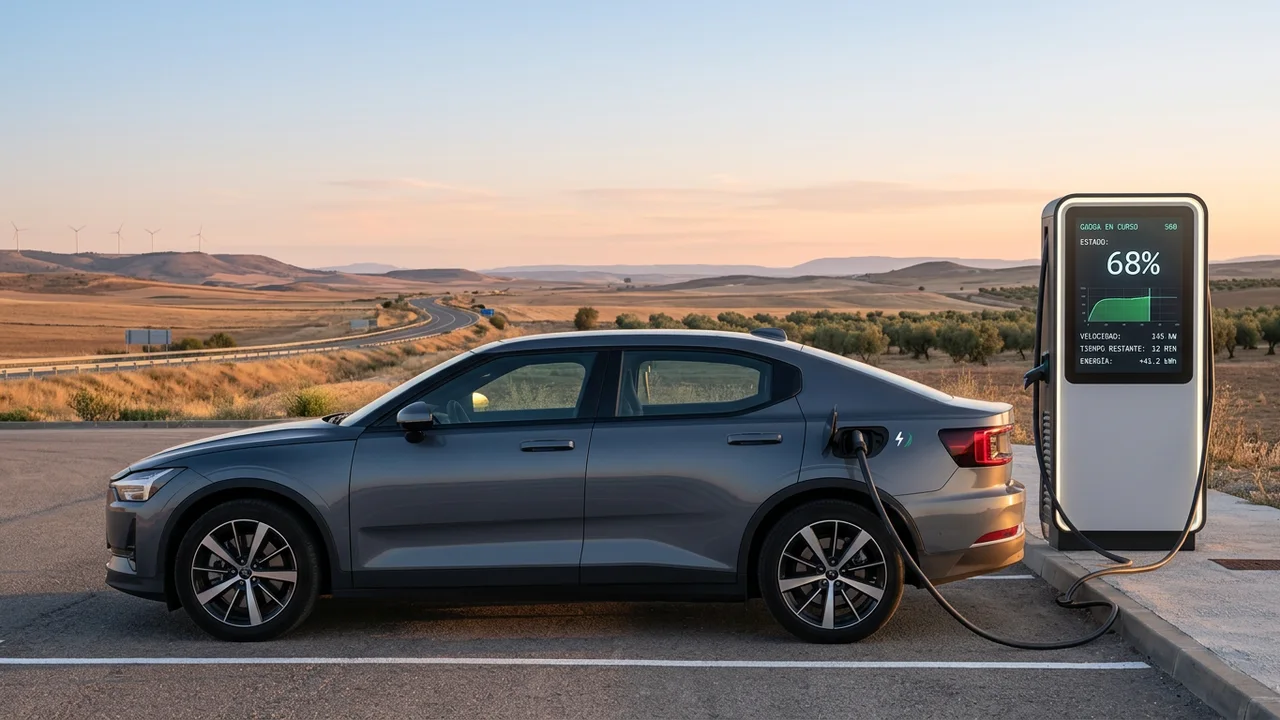
The 80% rule: why filling up ruins your average journey time
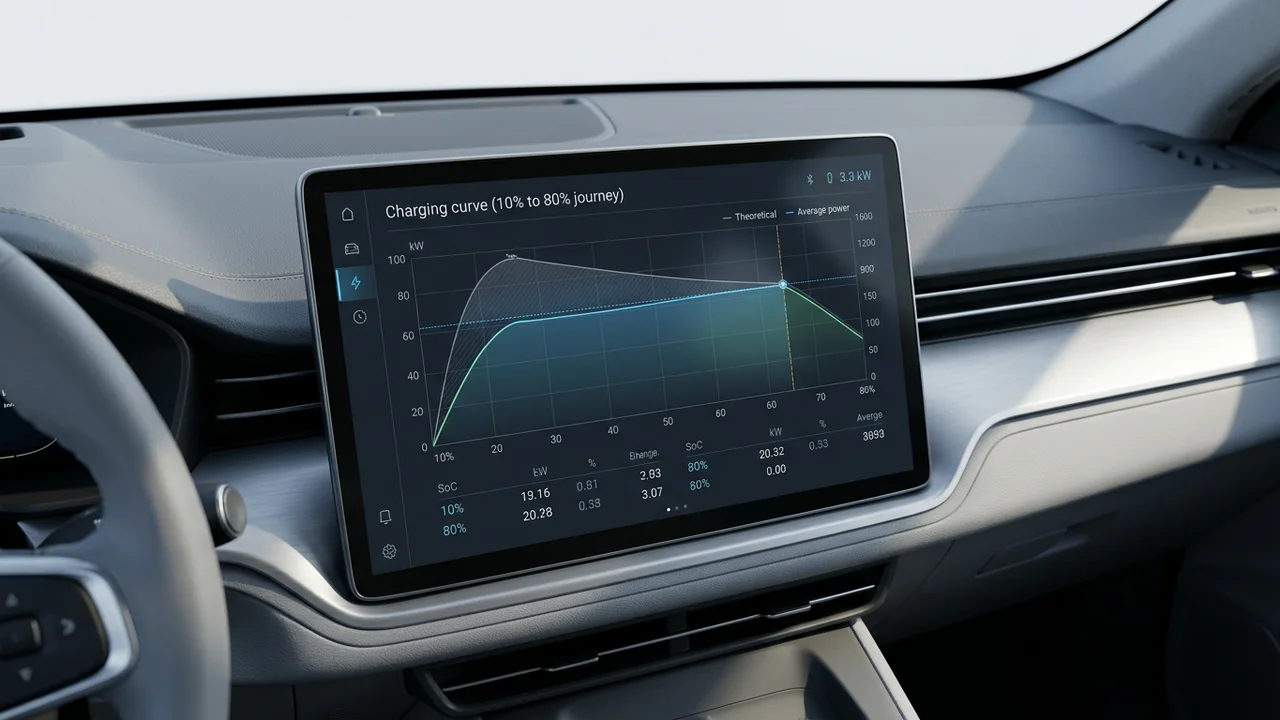
The charging curve is the technical progression that defines how many kilowatts (kW) of power the vehicle accepts at each exact battery percentage (SoC or State of Charge). No vehicle on the market charges at its advertised maximum power for the entire session. When the battery is between 10% and 40%, the internal resistance of the lithium cells is low, and the Battery Management System (BMS) allows high peaks (from 150 to over 250 kW depending on the model).
However, upon exceeding the 75%–80% threshold, the system switches to an absorption phase at constant voltage. Power plummets to 30–45 kW to safeguard cell chemistry and prevent dendrite formation. According to technical curves documented by homologation platforms like EVKX, going from 80% to 100% usually requires an additional 30 to 45 minutes, practically the same time it took to go from 10% to 80%. To delve deeper into managing these sections on the road, you can review our guide on how to optimise rapid charging on long EV trips.
Section comparison for a 75 kWh battery
Let's assume a stop at an ultra-rapid 300 kW charging point with motorway consumption of 19 kWh/100 km:
- 10% to 80% section (52.5 kWh injected): Completed in about 24 minutes. Provides approximately 275 km of real range at legal speed.
- 80% to 100% section (15 kWh injected): Takes an additional 28 to 35 minutes. Barely provides an extra 78 km.
Remaining plugged in beyond 80% at a public roadside charger reduces the effective average journey speed and unnecessarily blocks the charging point for other users.
Plan with QuantumDrive, travel with peace of mind.
Discover your optimal route taking into account charging points and your real range.
Charging times according to charger power and car architecture
The exact waiting time is determined by the most restrictive link: the power supplied by the charging point or the maximum power admissible by the vehicle. Furthermore, the battery's electrical architecture has a decisive influence: traditional 400-volt systems require very high current intensities to exceed 150 kW, which raises the internal temperature and forces early power drops. In contrast, the 800-volt architectures found in manufacturers such as Hyundai (with models like the Ioniq 5 or Ioniq 6) or Kia (EV6) allow for sustained power of 240–260 kW, reducing the stop to just 16–18 minutes.
| Type of on-route charger | Actual delivery power | Vehicle architecture | Estimated time (10%–80%) | Km recovered (at 19 kWh/100 km) |
|---|---|---|---|---|
| Standard Rapid (DC) | 50 kW continuous | 400 V / 800 V (secondary network) | 50 – 60 minutes | ~240 – 275 km |
| Super Rapid (DC 400 V) | 150 kW peak | 400 V (mid-range) | 25 – 32 minutes | ~270 – 300 km |
| Ultra Rapid (DC 400 V) | 250 kW peak (e.g. Tesla V3/V4 network) | Optimised 400 V | 20 – 26 minutes | ~280 – 320 km |
| High-voltage Ultra Rapid (DC) | Up to 300–350 kW | Native 800 V (Ioniq 5, EV6, Taycan) | 16 – 18 minutes | ~300 – 330 km |
Quick estimation formula on the road
To roughly calculate how many hours your rapid charging session will last, use the following mathematical relationship:
$$\text{Charging time (hours)} \approx \frac{\text{Net capacity to inject (kWh)}}{\text{Average effective power of the curve (kW)}}$$
Practical rule: The actual average power over a 10% to 80% cycle is usually between 20% and 30% below the peak maximum advertised by the manufacturer.
Factors that extend your stop: temperature, preconditioning and load sharing
Arriving at a 300 kW charger doesn't guarantee that the vehicle will immediately recharge at that figure. Various environmental and infrastructure factors can extend your stop by 15 to 30 unexpected minutes if not managed properly.
1. Lack of thermal preconditioning
The thermal management is the active control of liquid heating or cooling that keeps the battery cells in their ideal operating window (usually between 25°C and 35°C). If you travel in winter with outside temperatures below 10°C and do not program the stop in the vehicle's integrated satnav, the battery will arrive cold. According to technical reports from the motoring club The AA, a cold battery limits the initial power to 40–50 kW until it warms up through the current flow itself, adding an extra 15 to 25 minutes to the session.
2. Arriving with too high a state of charge (SoC)
Plugging in your EV with 40% or 50% charge remaining usually prevents the system from reaching its peak power. If you plan to arrive at the charging station with a 10% to 15% buffer, the cells will accept the maximum available current from the first minute, speeding up the overall process. To know exactly what to look for before plugging in, take a look at our guide on what to check before plugging into EV charging points (Available in Spanish).
3. Power Sharing between sockets
Many ultra-fast charging points have two CCS2 cables powered by a single power module (e.g., 150 kW or 200 kW shared). If another user plugs into the adjacent cable on the same power cabinet as yours, the charging station will split the supply 50/50, limiting your speed to 75 or 100 kW regardless of your vehicle's capacity. At charging stations with separate free bays, always choose independent charging points.
How much does it cost to charge on the motorway and how to pay at charging points?
The cost of electricity on the road is higher than domestic overnight charging due to the investment in high-voltage transformer stations and maintenance. In Spain, direct tariffs from operators such as IONITY, Zunder, Repsol, or Tesla stations open to non-Teslas typically range between €0.54/kWh and €0.66/kWh without monthly subscriptions. If you make frequent journeys, subscribing to an operator or mobility provider reduces these figures to between €0.35 and €0.45/kWh.
Example budget for a 250 km stretch
A car with motorway consumption of 18.5 kWh/100 km requires approximately 46 kWh to cover a 250 km journey with a safety margin:
- With direct ultra-rapid charging (€0.58/kWh): The cost of the stop is around €26.68 (€10.67 per 100 km).
- With a subscribed tariff (€0.39/kWh): The cost drops to €17.94 (€7.17 per 100 km).
Regarding payment, the entry into force of the European AFIR Regulation mandates that all publicly accessible rapid DC EV charging points must incorporate point-of-sale terminals (physical POS or contactlessreader) for direct payment by credit or debit card, eliminating the mandatory need to download specific applications before plugging in.
Beware of inactivity fees: To prevent EV charging points from being blocked after the session ends, operators penalise undue occupancy. According to Tesla's official idle fee conditions, the surcharge ranges from €0.50 to €1.00 per minute if the charging station is 50% or more occupied and the vehicle is not moved within minutes of completing the set charge.
Operational strategy: 4 steps to minimise journey times
To make your long journeys as smooth as in a combustion vehicle, apply these four travel guidelines:
- 1. Mark the charging station in the native satnav: Select the charging point in the vehicle's integrated GPS so that it automatically starts battery thermal preconditioning 20–30 km in advance.
- 2. Arrive with a low SoC (10%–15%): Push your arrival at the charging station with a prudent margin. It is in this range that the battery accepts the highest peak power rates.
- 3. Disconnect when reaching 75%–80%: Resume your journey as soon as the curve starts to drop below 50 kW. It is much faster to make a second 15-minute stop 200 km further on than to wait an additional half an hour at the same charging point.
- 4. Synchronise the stop with your personal needs: The time required to go to the toilet, have a coffee, or eat coincides with the 20–25 minutes needed to recover 300 km of range at a high-power charging point.
Related articles for planning your route
How to optimise rapid charging on long journeys
Learn to manage your vehicle's power curves and coordinate strategic stops at high-speed corridors.
What to check before plugging in your EV (Available in Spanish)
Identify connectors, actual power, direct payment systems, and ways to avoid shared or faulty charging points.
Real range calculator
Estimate your battery's real range on the motorway based on average speed, weather conditions, and your route's elevation profile.
QuantumDrive plans your route considering your actual conditions.
Discover your optimal route taking into account charging points and your real range.
Frequently asked questions about roadside charging times
How much real time is lost charging on a typical 500 km journey?
On a journey of about 500 km, an EV with a 60 to 77 kWh battery starting at 100% from the origin typically requires a single intermediate stop of between 20 and 28 minutes to reach its destination with a safety margin. This time coincides with the recommended break every two hours of driving on the road.
Why doesn't my vehicle reach the charger's maximum rated power?
The power is regulated by the car's own BMS. If the battery is cold (lack of preconditioning), if the initial charge percentage is above 40%, or if the charging station shares power with another adjacent charging point via power sharing, the power delivery will automatically be adjusted downwards to safeguard the durability of the lithium cells.
Is continuous rapid charging on a journey detrimental to battery degradation?
Modern liquid cooling systems effectively mitigate thermal stress. Technical data confirms that current batteries retain between 88% and 92% of usable capacity after 250,000 km, even with regular use of rapid charging on motorways, provided the car is not left parked at extreme temperatures charged to 100%.
Can I pay with a physical bank card if I don't have the charger's app installed?
Yes. Since April 2024, the European AFIR Regulation requires all DC charging stations to have a contactless card reader (POS) for ad-hoc payment without prior contracts or the need to register on each operator's mobile platforms.
Is it worth charging to 100% if the next charging station is far away?
Only if the topographical distance or lack of intermediate infrastructure strictly requires that range to avoid compromising the safety margin. In any other case, it is inefficient, as the final stretch from 80% to 100% usually requires an additional 30 to 45 minutes of waiting at reduced power.