
Buying Guide and Specifications
Auditing a used EV requires abandoning the traditional mechanical mindset. The key to residual value lies in battery chemical degradation, the charging standard, and the state of the power electronics.
Quick summary
- Demand a health certificate (SoH): Do not accept the dashboard percentage (SoC). An independent degradation test costs between €100 and €150 and measures the actual usable kilowatt-hours (kWh).
- Technical safety threshold: The average annual loss is around 1.8% - 2.3%; if a 4-year-old unit drops below 75% SoH (and especially below the critical 70% threshold), dismiss the deal unless there's a substantial reduction equivalent to the replacement cost (€8,000 to €20,000).
- Factory warranty linked to the chassis: The standard 8-year or 160,000 km coverage transfers to the buyer, but requires a service book stamped by an authorised network to be valid.
- Discard CHAdeMO sockets for long journeys: Demand a European CCS2 (Combo) connector. CHAdeMO charging points are falling out of use on Spain's motorways and severely limit road trips.
- Audit the 12V battery and coolant: An auxiliary battery older than 3 or 4 years causes phantom software faults and high-voltage start-up blocks.
How to audit battery health (SoH) and what threshold to accept?
The battery's State of Health, referred to as SoH (State of Health), represents the percentage of net usable capacity the battery retains compared to its factory specifications. It is vital to differentiate it from SoC (State of Charge), which only reflects the instantaneous charge percentage from 0 to 100% at that moment.
In Spain's vehicle fleet, the average expected degradation ranges between 1.8% and 2.3% annually under normal conditions. Continuous high-power DC charging or prolonged periods at 100% charge under extreme heat accelerate chemical ageing. To make a prudent decision, always compare homologation data with the real consumption of an EV (Available in Spanish) to calculate the energy cost per 100 kilometres.
Professional diagnostic criteria: Never buy relying solely on the onboard display. Connect an OBD reader with model-specific software or commission a dynamic test with independent companies such as Aviloo Battery Diagnostics (typical cost €100 to €150). If the SoH drops below 75%, the vehicle is approaching critical range loss and a replacement cost of between €8,000 and €20,000 depending on the pack size.
To analyse the original specifications before inspecting the physical unit, you can consult QuantumDrive's tool: the QuantumDrive catalogue compares 579 EV models with their charging curves and factory capacities.
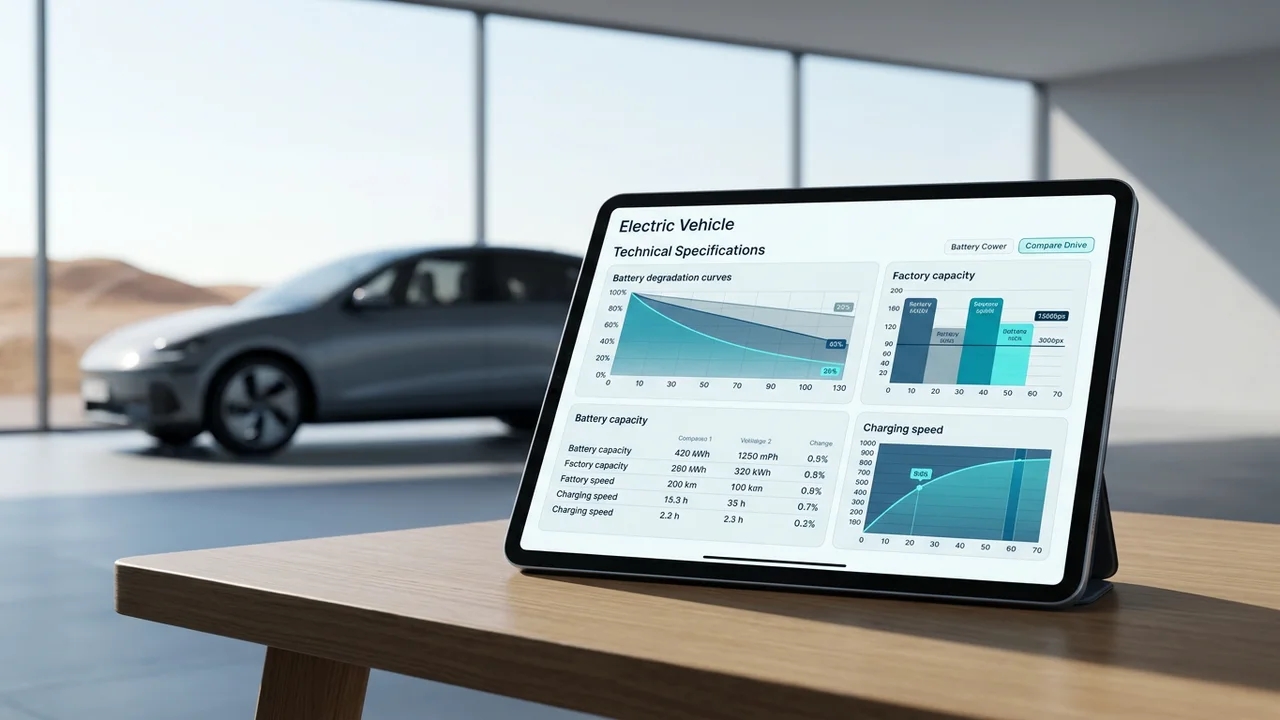
Official warranty and legal coverage in professional sales
The official warranty for the traction battery is the main financial safeguard when acquiring a used vehicle. The vast majority of brands offer 8 years or 160,000 km guaranteeing a minimum retention of 70% usable capacity. As it is associated with the chassis number (VIN) and not the owner, it transfers to the new owner, provided that the periodic services stipulated by the manufacturer are accredited.
Legally, there are notable contractual differences depending on the seller in Spain:
- Professional sale: Regulated by Royal Decree-Law 7/2021 through the Official State Gazette. Establishes a minimum agreed warranty of 1 year (2 years by default), with a presumption of lack of conformity favourable to the buyer.
- Private sale: Governed by the Spanish Civil Code. It only offers a 6-month period to claim for hidden defects, with the buyer bearing the cost and burden of judicial expert assessment to prove that the damage existed before the sale.
Charging ports and internal power: avoid obsolete standards
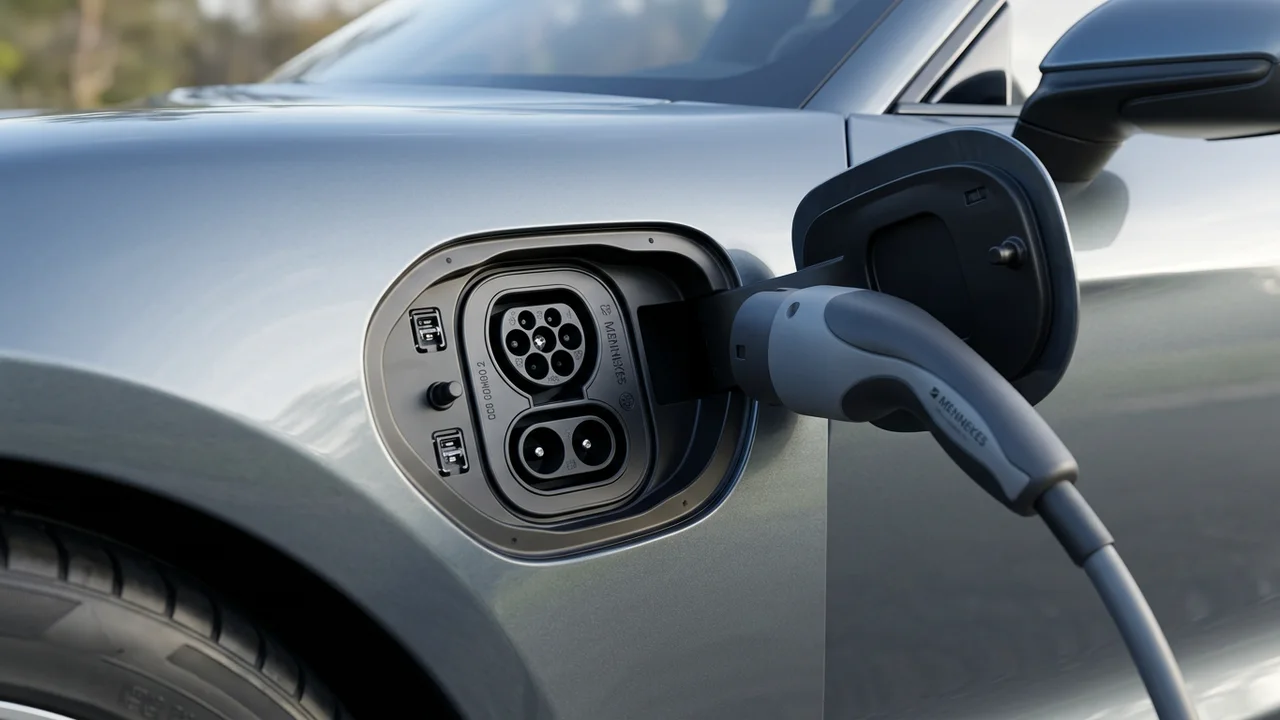
The fast charging connector standard completely dictates the vehicle's usability. Pioneer models from brands like Nissan or early Kia vehicles used the Japanese CHAdeMO connector for direct current. In Spain, public high-power networks have prioritised the European CCS2 (Combo) standard, relegating CHAdeMO to stagnation or progressive withdrawal.
For alternating current (AC), you must check what power the onboard charger (OBC) supports. While some basic versions are limited to 3.7 kW or 7.4 kW single-phase, other units support 11 kW or 22 kW three-phase, which drastically reduces charging hours at urban charging points. Before travelling to charge, it is advisable to review the guidelines on EV chargers (Available in Spanish) to assess compatibility and actual power.
| Standard / Connector | Typical power supported | Recommended scenario | Drawbacks for second-hand | Decision criterion |
|---|---|---|---|---|
| CCS Combo 2 (DC) | 50 kW to 150+ kW | Intercity journeys and intensive mixed use | Check for physical wear on the lower high-voltage pins | Priority choice; full compatibility across the entire peninsular network |
| Mennekes Type 2 (AC) | 7.4 kW (single-phase) to 11-22 kW (three-phase) | Tethered home charging and destination charging points | Check if the on-board inverter is capped at 3.7 kW | Essential; always request the original Mode 3 charging cable |
| CHAdeMO (DC) | Up to 50 kW | Strictly urban journeys with private garage | Charging network in clear decline with no new installations on corridors | Discard if frequent motorway travel is planned |
| Domestic Schuko (Mode 2) | 2.3 kW (10 A at 230 V) | Slow overnight charging or occasional emergency use | Thermal risk if the domestic socket does not have a dedicated circuit | Demand the emergency charging cable shows no signs of scorching |
Calculation of actual retained range versus WLTP cycle
The WLTP-approved figure on a new car's technical sheet is not a direct metric for a used vehicle. Chemical degradation reduces the battery's energy capacity, and driving on motorways at 120 km/h or in low temperatures penalises consumption compared to laboratory tests. To understand why this discrepancy occurs, review the key points on the difference between real-world range and WLTP approval.
To estimate a conservative motorway range for a second-hand unit, apply the following practical formula:
Motorway range estimation formula:
Estimated real range (km) = Official WLTP range × (Current SoH / 100) × 0.80
The 0.80 factor adjusts for the usual discrepancy between the approved mixed cycle and aerodynamic and thermal resistance at a sustained 120 km/h.
Mini calculation example and cost per journey:
Let's take a compact EV with a 400 km WLTP rating and a diagnosed SoH of 82%:
Real range on the road = 400 × 0.82 × 0.80 = 262.4 km
To cover 250 km on the motorway with a consumption of 18 kWh/100 km (45 kWh total): charging at home at €0.15/kWh the cost amounts to €6.75; at a rapid charger en route at €0.55/kWh the cost is €24.75. You can simulate different scenarios with the real-world range calculator.
Pre-purchase technical checklist: critical elements beyond the motor
Although an electric motor drastically reduces friction parts compared to an internal combustion engine, auxiliary and high-voltage components require a detailed inspection:
- 12 V auxiliary battery: Powers the relays that connect the high-voltage pack and on-board electronics. If it's over 3 years old, its wear causes random software errors and sudden immobilisations.
- Liquid cooling circuit: Check the level and colour of the dielectric coolant fluid. Replacement due to ageing or improper bleeding requires vacuum equipment in specialised workshops.
- Charging port and locking mechanism: Inspect the pins for discolouration due to overheating and ensure the actuator securely locks the plug when starting the charging session.
- Tyre tread wear: The extra weight of the cells (between 300 and 600 kg) and instant torque cause uneven wear on the shoulders if the suspension geometry has play.
- Corrosion in the braking system: Regenerative braking means the friction calipers work less, facilitating rust on discs and seizing in the rear wheel cylinders.
Essential administrative history and official reports
Before committing a deposit, request a full vehicle report from the DGT. This official document confirms the absence of judicial embargoes, financial retention of title, and certifies the mileage recorded at each MOT inspection.
In the regulatory context, Regulation (EU) 2023/1542 introduces the Digital Battery Passport from 18 February 2027, guaranteeing audited data on the battery's lifecycle and composition. Until then, buyer protection relies on auditing invoices, workshop records, and manufacturer service campaigns.
Regional grants and incentives: In programmes managed by the IDAE (such as the MOVES Plan calls), the purchase of a used vehicle has only been eligible for grants if it corresponded to demonstration units or nearly new vehicles registered by an official dealer with a maximum of 12 months old. Transactions between private individuals are excluded from these aids.
Electromobility could be your best investment.
Discover how much you could save on maintenance by buying an EV.
Recommended articles on range and charging
Real consumption and cost per kilometre
Learn to break down real consumption on motorways and in the city versus the approved figures with our guide on real EV consumption (Available in Spanish).
Road trip range calculator
Enter your battery capacity and state of health percentage to predict stops using the real-world range calculator.
Guide to connecting to public charging points
Check what power, connectors, and tariffs you should verify before plugging in with our guide to EV charging points (Available in Spanish).
Frequently Asked Questions
What is the minimum recommended battery State of Health (SoH) percentage when buying second-hand?
An SoH above 80-85% is the appropriate threshold for models that are 4 to 6 years old. Values below 75% lead to a noticeable penalty in real-world range on the road and drastically reduce resale value.
Is the official battery warranty transferred to the second buyer?
Yes, the manufacturer's warranty (usually 8 years or 160,000 km retaining at least 70% of useful capacity) is linked to the Vehicle Identification Number (VIN). It is essential that the vehicle has recorded official services.
What limitations are there when buying a used EV with a CHAdeMO socket?
The CHAdeMO standard is falling out of use in Spain's public high-power network. Although it allows domestic charging with an AC Mode 3 cable, it severely limits long motorway EV trips due to the lack of new compatible charging points.
How much does an independent technical test of the battery pack's condition cost?
A battery health report via an OBD connector or a certified dynamic discharge test usually costs between €100 and €150, an essential check before buying to avoid battery pack replacements costing between €8,000 and €20,000.
What legal guarantee does buying from a private seller offer compared to a dealership?
A professional dealer is obliged by Royal Decree-Law 7/2021 to offer at least a 1-year warranty on the vehicle. Between private individuals, only the Civil Code's hidden defects regime applies for 6 months, with the buyer having to judicially prove the prior defect.